Richard stopped.
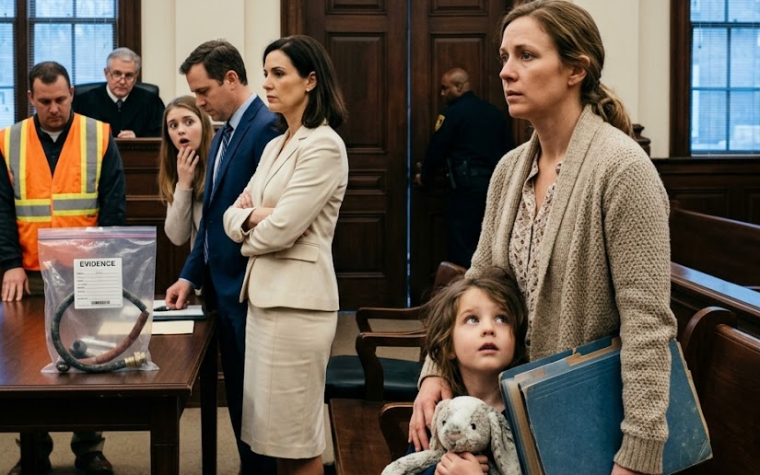
The principal looked at the camera, the evidence sleeve, and the investigators surrounding the desk.
Then he looked at Max, whose face had gone gray.
“I changed the reports,” the principal admitted.
Richard swore at him.
The principal kept speaking.
“He threatened to cancel the library donation.
He said he would replace me through the board.
Today, after the ambulance left, he ordered me to delete the stairwell footage before Mrs.
Elena arrived.”
“I never ordered anything,” Richard snapped.
“You said, ‘Make the camera problem disappear.’”
“You misunderstood.”
“You sent it in a message.”
Richard’s mouth closed.
The principal reached slowly into his pocket and surrendered his phone.
That phone contained the message, along with several others discussing previous complaints.
It also contained a photograph of the check Richard planned to offer me.
He had sent the image to the principal with one sentence beneath it.
She will take the money.
People like her always do.
I read that message later.
It did not hurt because Richard thought I was poor.
I had lived through his contempt before.
It hurt because, while my daughter was being examined for a brain injury, he had reduced her pain to a number he believed I could be pressured into accepting.
During our marriage, Richard had measured everything that way.
He measured loyalty by obedience, respect by fear, and love by what it could purchase for him.
When his family demanded that he choose between their fortune and our marriage, he did not hesitate.
He left with a suitcase, a legal team, and the same expression he had worn in the principal’s office.
“You’ll understand someday,” he told me then.
“Money is what survives.”
He expected me to disappear after the divorce.
Instead, I completed my training, joined the state bureau, and built a life that did not depend on his approval.
He knew vaguely that I worked for the government, but he never asked what I did.
In Richard’s mind, anything that did not make a person wealthy could not make them powerful.
That arrogance was now sitting inside an evidence file.
A juvenile officer arrived for Max.
Because he was a minor, he was not handcuffed or paraded through the hallway.
He was escorted to a separate room for an interview with appropriate counsel and child-services staff present.
I did not want a child publicly humiliated.
I wanted him stopped before his father’s protection taught him to become something worse.
Max initially claimed my daughter had tripped.
When investigators showed him a still image from the stairwell footage, he changed his story and said the push was a joke.
When they asked why he left without helping her, he began to cry.
Finally, he admitted that he believed nothing would happen to him.
“My dad fixes things,” he said.
Those four words became the center of the entire investigation.
Richard did not fix what followed.
The school board placed the principal on immediate administrative leave and barred Richard from all district property.
An outside firm began reviewing disciplinary cases connected to his donations.
Families who had previously withdrawn complaints were contacted and offered independent interviews.
The police chief voluntarily disclosed his social relationship with Richard and recused his department from the case.
A state ethics review later determined that Richard had repeatedly exaggerated the chief’s willingness to protect him, using their golf outings to frighten people into silence.
Richard’s influence had always depended partly on what he possessed and partly on what he convinced others he possessed.
Once people stopped believing him, his empire became smaller very quickly.
The investigation lasted several months.