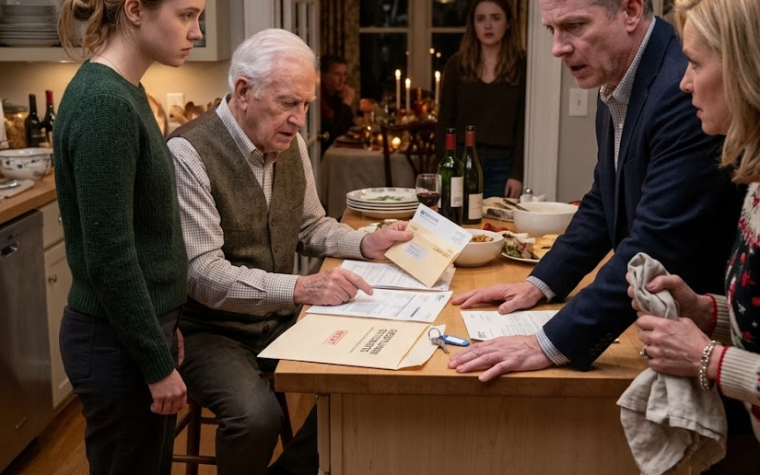
The third concerned the condominium purchase.
Bradley stopped reading.
Tiffany leaned toward him.
“What is it?”
“Nothing.”
He folded the pages too quickly.
Margaret had reached the doorway by then.
“Bradley?”
“I said it’s nothing.”
But Brittany had spent enough years watching her brother lie to recognize the sound of panic.
She stepped closer.
“What did Sarah do?”
Bradley looked at her.
That question told Tiffany everything she needed to know.
“This is about Sarah?” she demanded.
Bradley shoved the papers back into the envelope.
The doctor asked them to take the disagreement outside so the appointment could conclude privately.
Tiffany climbed off the examination table, furious now rather than frightened.
“You said the divorce was done.”
“It is done.”
“Then why is her lawyer sending you papers here?”
Margaret stared at him.
“Her lawyer?”
That was the part none of them had expected.
For months, Bradley had spoken about me as though I were too tired, too dependent, and too frightened to do anything except accept whatever he offered.
He had told his family the penthouse was his.
He had told them the SUV was his.
He had told them I had no money to fight.
And that morning, when I quietly left my keys behind, he had taken my silence as proof.
What he had never understood was that I stopped arguing because I had finally started documenting.
Months earlier, I had noticed that ordinary expenses suddenly became arguments.
Groceries.
Connor’s camp.
Madison’s shoes.
Bradley had begun questioning every small purchase while money vanished in amounts too large to be explained by household bills.
When I asked where it was going, he accused me of being controlling.
When I asked again, he told me I did not understand finances.
So I stopped asking him.
I began keeping records.
That was how I eventually found Harrison.
He did not promise revenge.
He told me something much more useful.
Facts first.
If Bradley truly owned everything separately and had disclosed everything honestly, then the records would show that.
If he had not, the records would show that too.
Harrison began comparing statements, transfers, dates, and the disclosures Bradley provided during mediation.
The pattern became difficult to ignore.
Money had moved while Bradley was telling me there was nothing available for the children.
Large transfers appeared around the same time he and Tiffany were photographed inside the luxury real estate office.
Then Harrison obtained the purchase contract.
The condominium was not merely a future dream they had toured together.
Money had already been committed to it.
And some of those funds overlapped with accounts and periods Bradley had treated as irrelevant or nonexistent during the divorce discussions.
Harrison warned me not to confront him.
A confrontation would only teach Bradley what we knew.
So I waited.