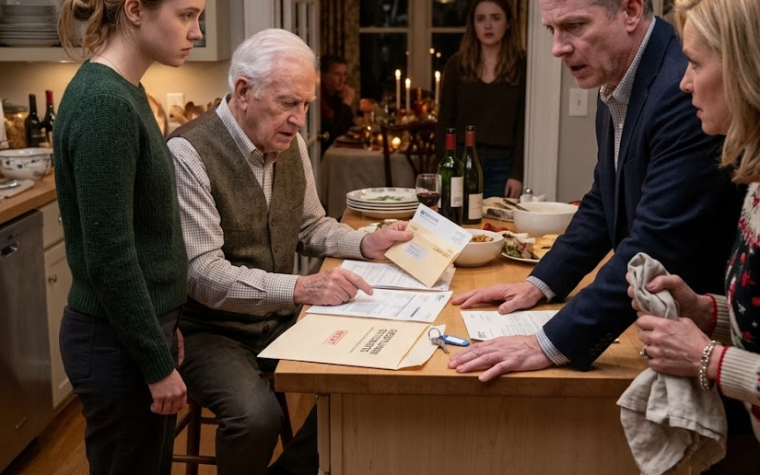
The sentence Evelyn had underlined twice was only seven words long.
“Anna is not your biological daughter.”
I read it once.
Then again.
Then a third time, because my mind kept rejecting the arrangement of the words even though I understood every one of them.
Across the kitchen, Anna was crying so quietly that the rain against the window sounded louder.
I looked at her face.
Twenty-three years old.
Evelyn’s dark eyes.
My habit of pressing her lips together when she was frightened.
The small scar near her eyebrow from falling off a bicycle when she was eight.
The girl I’d carried into an emergency room at midnight.
The child whose shoes I’d tied, whose school plays I’d recorded, whose first apartment I’d helped furnish.
Not my biological daughter.
My daughter.
Both thoughts existed at the same time, and for several seconds I couldn’t make them fit together.
“Dad,” Anna whispered.
I raised one hand.
“Let me finish.”
My voice sounded unfamiliar.
I looked back at Evelyn’s letter.
The next paragraph began with an apology.
She wrote that there was no graceful way to confess what she had done.
Years before Anna was born, during the ugliest period of our marriage, Evelyn had been unfaithful once.
She had ended it quickly, buried it, and convinced herself that silence could protect the life we were rebuilding.
Then she became pregnant.
She told me that Anna was ours.
And for years, according to the letter, Evelyn had believed that herself because she wanted to believe it.
When Anna was still small, doubt finally became stronger than denial.
Evelyn arranged a private paternity test without telling me.
The result told her what she had feared.
I was not Anna’s biological father.
My fingers tightened around the paper until it crackled.
Evelyn’s handwriting became less steady as the letter continued.
“I told myself I was protecting you,” she had written.
“That was a lie I used because the truth was uglier.
I was protecting myself.
I was afraid you would leave me.
I was afraid you would look at Anna and see my betrayal instead of the little girl who ran to the door every evening when she heard your truck.”
I stopped reading.
A memory came without permission.
Anna at four years old, wearing yellow pajamas, racing down the hallway because she’d heard my key in the lock.
“Daddy!”
She used to hit me at full speed, trusting that I would catch her.
I always did.
I closed my eyes.
“How much did you know?” I asked.
Anna wiped her face with her sleeve.
“Everything that’s in there.”
“You were thirteen.”
“I know.”
“Your mother gave you this sealed?”
Anna nodded.
“She was really sick by then.
She told me, ‘Give this to your father when you get home.
Don’t open it.'”