She frowned, trying to understand a rule that contradicted the one she had learned at home.
“What if you’re busy?”
“Then you tell me you’re hungry.”
“What if I’m bad?”
“You can make a mistake,” I said.
“You can break a rule.
You can be upset.
Food is not something you lose.”
She ate one apple slice and stared out the window.
That first week, I discovered how deeply the fear had settled into her routines.
Laya asked permission to drink water.
She folded empty snack wrappers and hid them beneath other trash.
At dinner, she watched my plate instead of eating from hers.
If I stood suddenly, she placed both hands in her lap.
I did not tell her to stop being afraid.
I made the house predictable.
I placed a small basket of approved snacks on the lowest pantry shelf.
I showed her where it was.
I explained that she could take one whenever she felt hungry and tell me afterward so I would know when to prepare the next meal.
The first day, she did not touch it.
The second day, one cracker packet disappeared.
I found the unopened packet under her pillow that night.
I did not confront her.
I sat beside her bed and said, “You don’t have to save that for an emergency.”
She held the blanket beneath her chin.
“What if tomorrow is bad?”
“Then there will still be food tomorrow.”
She looked at me as if I had promised something impossible.
The family specialist met with Laya through play rather than direct questioning.
She also interviewed me, Marissa, Becca, and the preschool director.
She reviewed the recordings and visited both homes.
Marissa maintained that she had been enforcing structure.
She accused me of encouraging Laya to disobey.
During one supervised visit, she asked Laya why she had told “private family stories” at school.
The supervisor ended the visit immediately.
That incident became another documented fact.
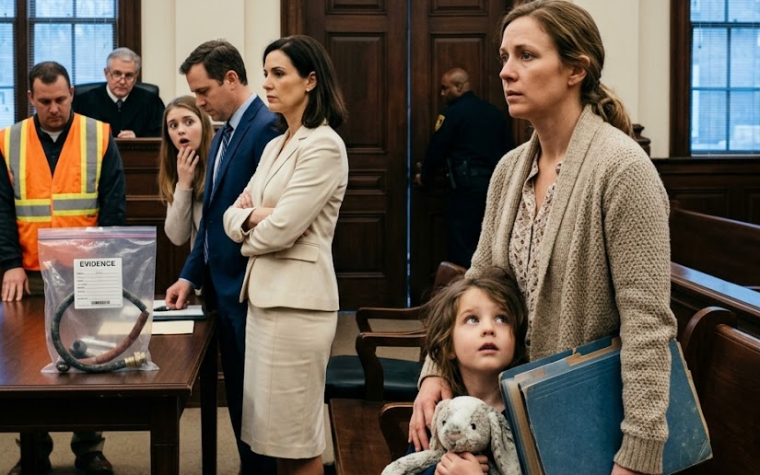
At the follow-up hearing, the specialist did not call Marissa evil.
She described her behavior more precisely: rigid control, poor emotional regulation, punishment disconnected from the child’s conduct, and a persistent refusal to recognize Laya’s hunger as a legitimate physical need.
She recommended continued supervision, individual treatment for Marissa, parenting education, and gradual reassessment only after Marissa demonstrated that she could follow boundaries without blaming Laya.
The court adopted the recommendations.
Marissa’s visits remained supervised.
Decision-making authority over Laya’s medical care, preschool, and daily routine was placed with me while the case continued.
The court also ordered that the preserved recordings remain sealed as evidence rather than circulating among relatives or online.
That mattered to me.
I wanted protection, not public spectacle.
Laya’s worst afternoons did not belong to strangers.
Several family members initially believed Marissa’s version.
She told them I had weaponized security cameras during a marital dispute.
I did not send them the videos.
I gave them one answer: the court had reviewed the evidence, and Laya was safe.
Some continued defending Marissa.
Others stopped after seeing Laya ask permission to eat a dinner roll at my sister’s house.
Months passed before Marissa acknowledged any responsibility.
Her first apology arrived through the supervised-contact coordinator and focused mostly on intent.
She had never meant to frighten Laya.
She had been stressed.