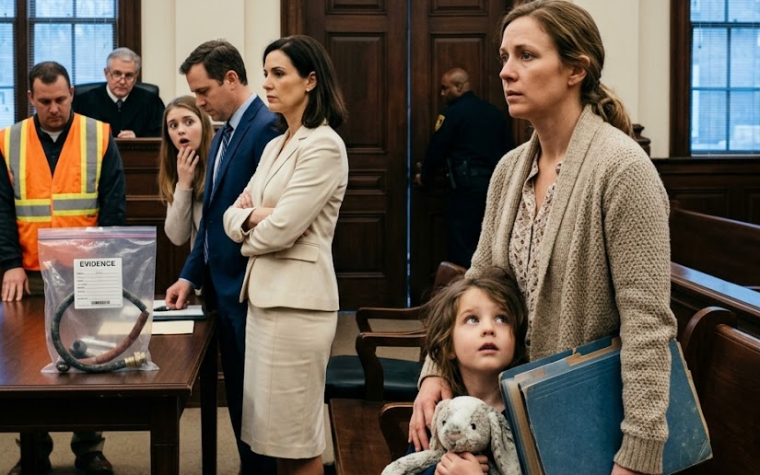
Once, she glanced at the courtroom door as if she expected to leave before anyone could tell her what happened next.
When they returned, her attorney offered an explanation.
Marissa had been under professional pressure.
She had been working on the Henderson proposal from home.
Laya had interrupted repeatedly.
The prolonged chair punishment, he said, had been an error made by an overwhelmed parent—not an attempt to deprive a child of food.
My attorney asked a single question.
“Why did Mrs.
Morrow eat in front of the child’s empty chair immediately afterward?”
There was no smooth answer.
Marissa supplied one anyway.
“Because they were grapes.
She doesn’t even like grapes.”
The judge’s expression changed.
The issue was not whether Laya liked grapes.
The issue was that Marissa still believed the type of food mattered more than the deliberate display of control.
The court ordered that Laya remain with me temporarily while a family specialist conducted an assessment.
Marissa’s contact would be supervised.
Neither parent was permitted to question Laya about the case, criticize the other parent in her presence, or remove her from preschool without written authorization.
It was not a final judgment.
It was not a dramatic declaration that erased every danger.
It was a locked door between my daughter and the person who had taught her to fear hunger.
Outside the courtroom, Marissa followed me into the corridor.
“You planned this,” she said.
My attorney stepped between us, but I raised one hand to show I would not engage.
Marissa’s voice sharpened.
“You made me look like a monster.”
I looked at her for the first time since the recordings played.
“I saved what happened.”
“That is not the same thing.”
“No,”
I said.
“It isn’t.”
She wanted an argument because arguments could be blurred.
She could accuse, redirect, cry, or force me to defend every hour I had worked late.
A timestamp could not be exhausted.
A five-year-old’s hidden crackers could not be cross-examined into becoming imaginary.
I left with my attorney and drove to preschool.
Laya was coloring when I arrived.
Becca had returned before us and was sitting nearby.
The moment Laya saw me, she looked toward the classroom clock.
“Am I leaving early again?” she asked.
“Yes.”
“Is Mommy home?”
The question was so quiet that Becca turned away to hide her face.
“No,” I said.
“You’re coming with me.”
Laya considered that answer carefully.
“Can I have a snack in the car?”
I had expected relief to feel like victory.
Instead, it felt like grief arriving late.
“Yes, Bug.”
I had brought apple slices.
She held the container in both hands but did not open it until I started the engine.
“Do I have to ask every time?”
“You never have to ask whether you’re allowed to be hungry.”