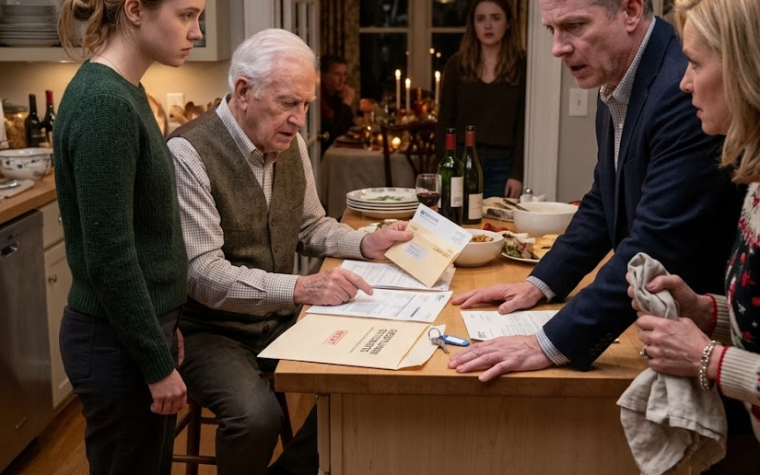
“This is his revenge.
He manipulated her from prison.”
Jonah rose but did not move toward him.
“You took three years of my life,” he said.
“You used my wife’s name to steal from families who trusted us.
This is not revenge.
It is an accounting.”
The board could not complete the merger that morning.
Jonah’s lawyer presented an emergency order obtained minutes earlier.
Based on my affidavit, the handwriting analysis, and the former accountant’s records, a judge had temporarily frozen extraordinary transfers from the charity and prohibited destruction of its files.
The board voted to suspend Jonah’s cousin pending a full investigation.
Without the forged proxy, he no longer had enough votes to stop them.
He left the room accompanied by his attorneys.
The controlled smile was gone.
In the hallway, investigators were waiting to collect the charity’s servers and financial records under a search warrant.
The consequences did not happen all at once.
Truth rarely arrives as cleanly as a prison gate opening.
Over the next several months, auditors traced the missing funds through consulting companies controlled by Jonah’s cousin.
Prosecutors added forgery, perjury, and obstruction charges to the theft case.
Some of the money was recovered.
Properties purchased with charity funds were seized and sold for restitution.
The former accountant accepted responsibility for her false testimony and cooperated with investigators.
The board members who had ignored discrepancies resigned.
Jonah’s mother stepped down from every family position and repaid the money she had used to hire me, even though it had come from her personal accounts.
She apologized to Jonah first.
Then she came to our apartment and apologized to me.
“I saw your need and treated it like leverage,” she said.
I did not forgive her immediately.
An apology could not return the choices she had taken from us.
But I listened, and for the first time she did not ask me to make her feel better.
Jonah was formally restored to his family seat.
His first act was to appoint an independent oversight committee with no relatives on it.
His second was to change the charter so that no spouse could inherit authority without informed, written consent.
He offered me a permanent position on the board.
I declined.
For three years, other people had decided what my marriage, my signature, and my desperation were worth.
I did not need another title chosen for me.
Instead, I helped select the independent trustees and then stepped away.
At home, the harder work continued.
Freedom did not erase prison from Jonah’s body.
He still woke at small sounds.
He ate too quickly.
He sometimes stood in doorways as if waiting for permission to enter his own rooms.
I still struggled with the fact that he had known about the payments and remained silent.
He struggled with the fear that my love had been another arrangement that could expire.
We began again without pretending the first beginning had been noble.
We talked about money.
Shame.
Anger.
The letters that had become real before either of us admitted it.
The eight days he had hidden the black box.
The three years I had hidden how much I needed his calls.
Months later, after his cousin entered a guilty plea and the charity announced its recovered funds, Jonah brought the annulment petition back to the kitchen table.
He tore it in half.
Then he placed our prison marriage license beside it.
“We never had a wedding where either of us knew the whole truth,” he said.