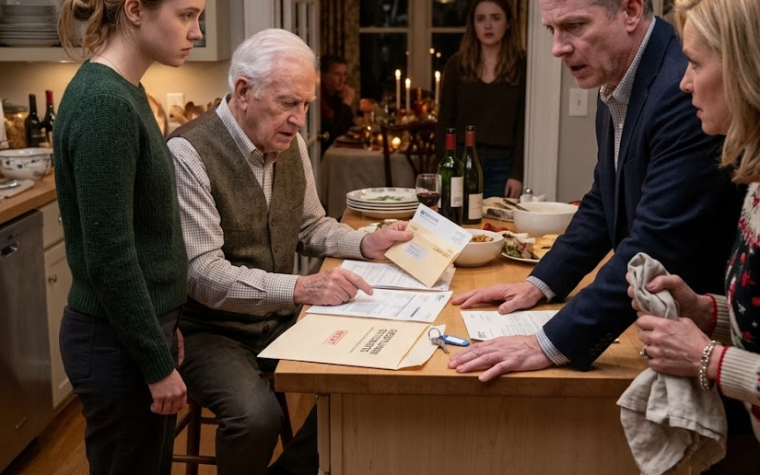
I drove home alone.
I did not confront him again that night.
Instead, I went into the small desk where we kept tax returns, pension statements, insurance papers, and old bank records.
I began making a list.
Accounts I knew.
Balances I remembered.
Transfers I had never questioned.
Tax refunds Harold said had gone toward expenses.
Bonuses he described as smaller than expected.
Our joint statements showed regular transfers to an account identified only by the last four digits.
Some were modest.
Six hundred dollars.
Nine hundred.
Twelve hundred.
Larger amounts appeared after bonuses and tax refunds.
Small enough month by month to disappear into ordinary household noise.
Large enough over fifteen years to become a house.
Harold came home just after eight.
He found me at the dining-room table with statements spread across it.
“I can explain all of that,” he said.
“I know.”
He pulled out a chair.
I closed the folder.
“I’m not asking you tonight.”
“What does that mean?”
“It means I’m done getting all my information from the person who hid it.”
The next morning, I redirected my pension deposit into an account I controlled and scheduled a meeting with an attorney.
I did not do it because I had already decided to end my marriage.
I did it because I finally understood how dangerous ignorance could become when one spouse called it trust.
The attorney did not promise me a dramatic courtroom victory.
She asked for documents, dates, account records, tax returns, property information, and anything showing how money had moved during the marriage.
When I showed her photographs from the closing folder, she leaned closer.
“Get complete records before anything disappears,” she said.
That sentence changed how I approached Harold.
I stopped arguing.
I started documenting.
Within a week, the outline became clear.
Harold had opened the investment account fifteen years earlier and fed it with money transferred from income earned during our marriage, along with refunds and bonuses that I had been told were needed elsewhere.
He had invested conservatively and accumulated far more than I knew existed.
The house payment was not proof that we had suddenly become wealthy.
It was proof that we had never been as poor as Harold required me to believe.
When I confronted him with the records, he changed explanations three times.
First, the account was for emergencies.
Then it was for retirement.
Then it was meant for the children.
Finally, when none of those explanations answered why I had been kept ignorant, he stopped pretending secrecy was accidental.
“I knew you wouldn’t understand,” he said.
That sentence ended the marriage more completely than any affair could have.
Because I did understand.
I understood that Harold did not see us as two adults making choices together.
He saw himself as the manager and me as a person whose behavior had to be controlled by limiting what she knew.
Our daughter called from Phoenix after her brother told her what had happened.
She was quiet for a long time.
Then she said, “Is that why you kept saying you couldn’t come visit?”
I looked at the calendar on our kitchen wall.
Three birthdays.