No marble donor wall.
No private entrance.
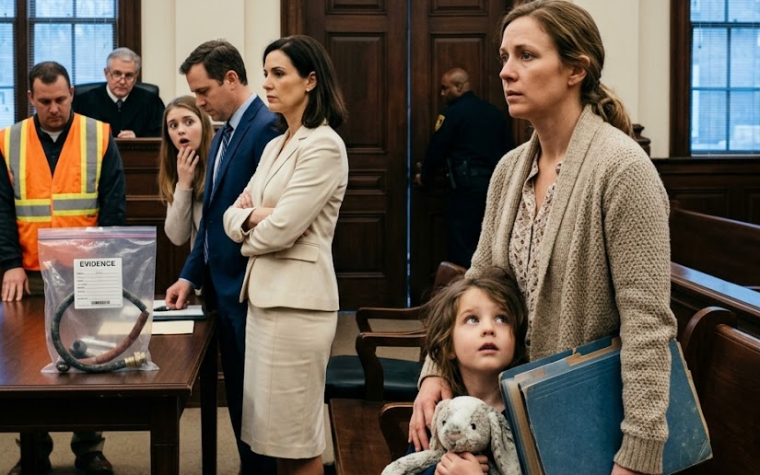
Just wooden benches, fluorescent lights, and a judge who had reviewed the evidence.
Tabitha arrived in a tailored cream suit.
She did not look at Clara until the emergency recording was admitted and played.
Her own voice transformed the room.
“Get rid of that baby, Clara, or we’ll get rid of you.”
Tabitha’s expression changed first to disbelief, then fury.
She leaned toward her attorney and whispered rapidly.
William sat behind her, pale and rigid.
The prosecutor synchronized the audio with the recovered security footage.
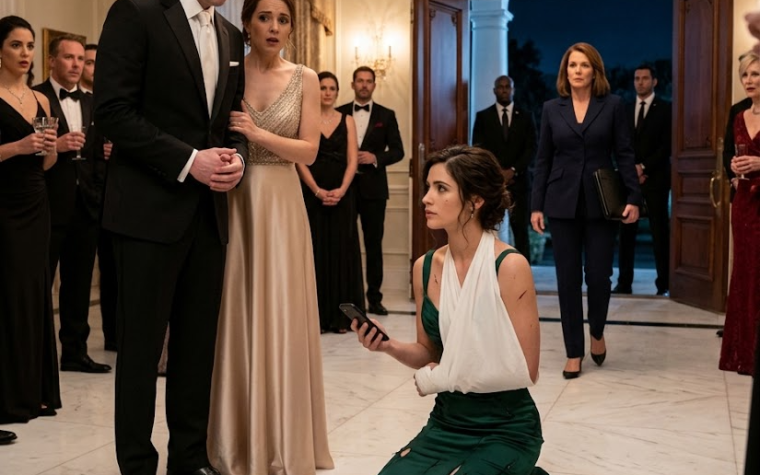
The court watched Tabitha seize Clara near the landing.
The sound of the fall came from the phone while the silent video showed William stepping into view.
Then came his sentence.
“Stop screaming.
You’re embarrassing me.”
William lowered his head.
His attorney later argued that he had been in shock and had not understood the severity of Clara’s injuries.
The porch recording destroyed that defense.
It captured him arriving with the prepared statement, threatening that his family would accuse Clara, and demanding her signature before she had received medical care.
Rosa testified about the cleanup order.
Lena testified about Tabitha’s prior violence.
A digital forensic specialist authenticated the emergency recording and cloud backup.
The physician who examined Clara explained the strangulation marks, fractured ribs, and risk to the pregnancy.
Dr.
Mercer invoked his right not to answer several questions while his own attorney sat beside him.
The Garcia family’s confidence weakened by the hour.
Eventually, the defendants stopped insisting that nothing had happened.
Their stories shifted toward minimization.
Tabitha had only pushed Clara away.
William had only tried to prevent scandal.
His mother had only wanted to protect a distressed daughter-in-law from public humiliation.
The judge was unmoved.
“Calling coercion protection does not change its nature,” she said.
The criminal cases did not end in a single dramatic sentence.
Real consequences arrived through months of hearings, negotiations, professional reviews, and sworn testimony.
Tabitha ultimately entered a guilty plea to serious assault charges after the court ruled that the recording and video were admissible.
She received a custodial sentence followed by supervised release, mandatory treatment, and a long-term protective order barring contact with Clara or her child.
William pleaded guilty to coercion and evidence-related charges.
His medical license was suspended, and the residency program dismissed him after an internal investigation found that he had misused professional relationships in an attempt to manufacture a psychiatric explanation for Clara’s injuries.
His mother accepted responsibility for evidence tampering and obstruction-related conduct.
She avoided prison because of her age, lack of prior convictions, and cooperation in the later stages of the case, but she received strict probation, community service, and substantial financial penalties.
Dr.
Mercer lost his hospital privileges and faced separate licensing discipline.
The hospital notified patients whose records he had handled in other questionable circumstances, triggering a broader audit.
The Garcia foundation removed William’s mother from its board.
Donors demanded independent oversight.
The family name remained on buildings, but it no longer opened every door without questions.
Clara’s divorce was finalized the following spring.
She did receive a fair share of marital assets, but not because the Garcias offered mercy.
Financial records showed that she had contributed earnings to the household, supported William during training, and signed nothing surrendering her rights.
Thomas made sure every agreement was reviewed by independent counsel so no one could claim he had used family influence improperly.
Clara kept her own name.
She moved into a modest house twelve minutes from mine, close enough for morning coffee and far enough to feel like her own life.
She attended therapy.
She learned that gentleness and boundaries could exist in the same person.