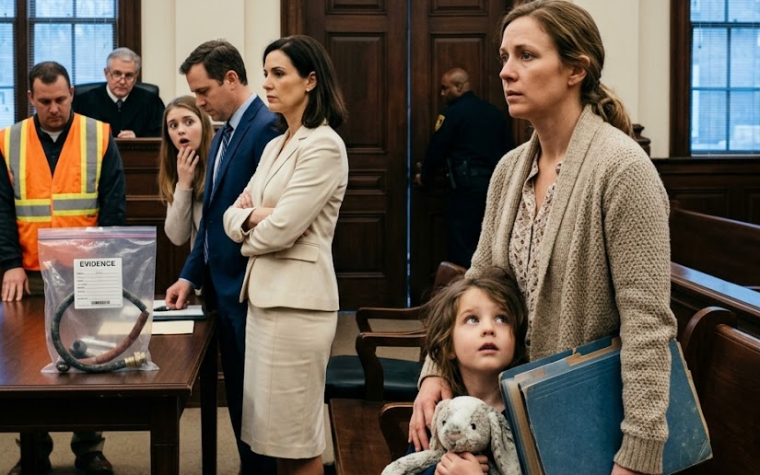
His medical license was suspended pending regulatory review.
Saint Jude permanently revoked his privileges.
The hospital issued a statement acknowledging failures in executive oversight and created an independent reporting channel for patients and staff who feared retaliation.
Cora filed for divorce and obtained a protective order.
Marcus violated it once by sending a message through a former colleague.
The message called her ungrateful and warned that the family would regret humiliating him.
That violation ended his release conditions.
He spent the remainder of the pretrial period under stricter supervision and without access to Cora.
The case ultimately ended in a plea rather than a public trial.
Marcus admitted to assault, intimidation, and attempting to interfere with a patient-safety investigation.
He lost his executive positions, his ownership interests, and the professional status he had used as armor.
The court imposed incarceration, long-term supervision, and permanent restrictions on contacting Cora.
None of that happened quickly enough to make the fear vanish.
Three days after we left Saint Jude, Cora went into labor.
At Mercy Women’s Center, the baby’s position and signs of fetal distress made a C-section the safest choice.
The moment the surgeon explained it, Cora began shaking.
“No,” she said.
“I can’t go to sleep.”
The anesthesiologist pulled a chair beside her bed.
She explained every medication, every monitor, and every person who would enter the operating room.
Cora would remain awake under regional anesthesia unless an emergency required otherwise.
A patient advocate would stay nearby, and I would be waiting just outside.
Nobody told her to calm down.
Nobody called her emotional.
Nobody asked her husband for permission.
Cora looked at me before they wheeled her away.
“What if he was right?”
I bent over and pressed my forehead to hers.
“He was wrong about the hospital.
He was wrong about the evidence.
He was wrong about your strength.
He is wrong about this too.”
The doors closed.
I waited beneath lights that were too bright, listening to carts move along the corridor.
Every minute felt like a punishment designed for mothers.
Then a nurse came through the doors smiling.
“Your daughter is awake,” she said.
“And your grandson is loud.”
When I entered recovery, Cora was holding a red-faced baby against her chest.
He made one angry sound, opened his eyes for half a second, and wrapped his hand around her finger.
Cora laughed and cried at the same time.
“I woke up,” she whispered.
“Yes.”
“He said I wouldn’t.”
“I know.”
She looked down at her son.
For months afterward, ordinary things frightened her.
Heavy footsteps in a hallway.
A blocked doorway.
A phone call from an unfamiliar number.
The smell of the lotion used in Saint Jude’s VIP clinic.
Recovery did not arrive like the emergency directive, immediate and official.
It came slowly.
One night of uninterrupted sleep.
One meal she chose for herself.
One bank account with only her name on it.