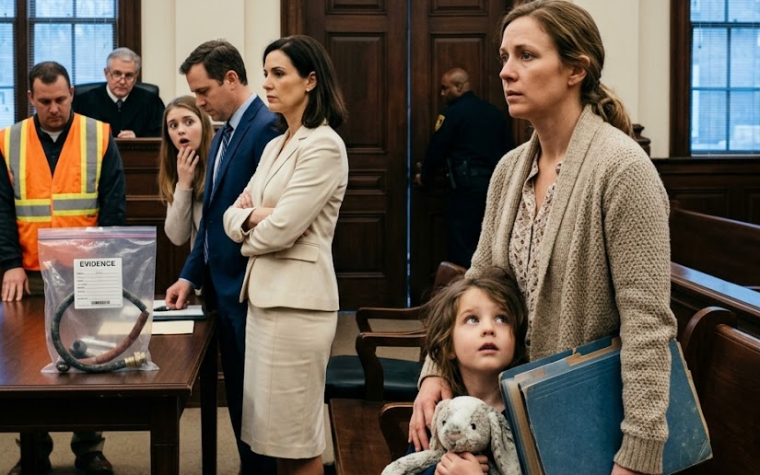
“I believe today’s service should end here.”
Nobody argued.
The blessing Cade had designed as a public declaration of his new life dissolved without music, without applause, and without the image he wanted people to carry home.
People began filing out in uneasy clusters.
Some avoided looking at us.
Others stared openly.
The same witnesses who had magnified my humiliation now magnified his accountability simply by being there.
I did not feel victorious.
I felt tired.
Victory is a loud word for the moment you recover something that should never have been taken.
Savannah remained near the altar with her father.
Cade tried speaking to her, but she turned away.
I did not stay to watch their argument.
That part was theirs.
Outside the chapel, the afternoon air felt heavy.
My daughter looked up at my closed fist.
“Do you have Grandma’s necklace?”
I opened my hand so she could see.
“Yes.”
“Can he take it again?”
The question hurt more than anything Cade had said inside.
I crouched to her height.
“No.”
This time, I intended to make sure of it.
Lydia walked us to the car.
Before I got in, she asked for the pearls so they could be photographed, documented as recovered, and secured until the immediate dispute was settled.
I handed them over willingly.
That evening, Cade’s attorney acknowledged receipt of the evidence and confirmed that the necklace had been returned.
In the weeks that followed, the footage and prenup became part of the divorce record.
The incident did not magically give me everything.
Real consequences were slower and less theatrical than church whispers.
There were meetings.
Statements.
Financial disclosures.
Arguments through lawyers.
Cade’s team tried to characterize the incident as a misunderstanding between spouses.
Lydia answered with the signed property schedule and two camera angles.
They tried to suggest he believed the emergency key gave him access.
Lydia pointed out that access to a room was not ownership of what was locked inside a safe.
They argued that the necklace had been returned without damage.
That fact helped resolve the property issue, but it did not erase how it had been taken or why.
Most importantly, Cade lost the advantage he had expected to carry into the divorce.
Until the chapel, he had treated me as if I would avoid conflict at any cost.
Afterward, every negotiation changed.
He knew I had preserved evidence.
He knew Lydia would use the agreements he had signed.
He knew I was no longer trying to protect his public image from the consequences of his private behavior.
The final settlement respected the separate-property provisions we had agreed to before the marriage.
My inherited belongings remained mine.
Cade kept what the prenup protected for him.
I kept what it protected for me.
There was no grand transfer of his fortune into my hands.
That had never been the point.
My mother’s real gift was not a loophole that made me rich.
It was clarity.
She had understood that people respect boundaries differently when those boundaries are written down, witnessed, and enforceable.