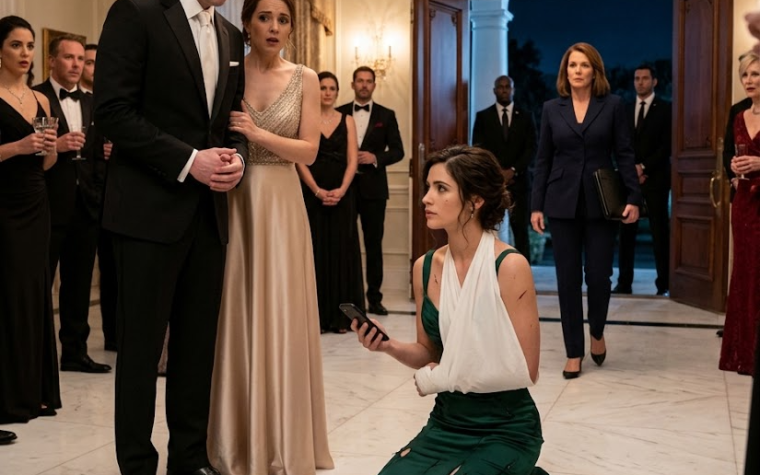
Evelyn kept one gloved finger beside Conrad’s signature while the reporters pressed closer.
He knew the document immediately.
He had signed it at 8:17 that morning in his office, between a conference call and a breakfast meeting, after his attorney had placed a stack of papers beside his coffee and told him the museum arrangements required final execution before the gala.
Conrad had barely looked at them.
He had been busy texting Marissa.
Now Evelyn turned the page toward him.
“You remember this?” she asked.
Conrad’s eyes moved across the paragraph marked by a narrow white tab.
His mouth opened, but nothing came out.
Marissa leaned around him.
“What is it?”
He snapped the folder shut.
“Nothing.”
Evelyn calmly put her hand on top of it.
“If it were nothing, you wouldn’t be trying to close it.”
Cameras clicked around them.
The museum director remained beside Evelyn.
The security chief stood between Conrad and the woman he had intended to humiliate less than three minutes earlier.
The reversal was so complete that even the reporters seemed uncertain whether to speak.
Conrad recovered first.
“You’re turning a private marital disagreement into theater.”
Evelyn looked at the carpet beneath his shoes.
“You kissed another woman in front of eighty-three cameras.”
A few reporters exchanged looks.
Conrad’s jaw flexed.
“That has nothing to do with whatever paperwork you’re waving around.”
“It has everything to do with it.”
She opened the folder again.
The contract was not a divorce agreement.
It was not a prenup.
It was not a theatrical document Evelyn had prepared simply to frighten him.
It was the final event and funding agreement Conrad himself had demanded be completed before that night’s benefit.
For months, Conrad had insisted that the gala continue using the Whitmore name.
He liked the photographs, the donors, the implication that the family’s philanthropy belonged to him.
But the charitable foundation had never been his creation.
It had begun with Evelyn’s inheritance, Evelyn’s board appointments, Evelyn’s donor relationships, and years of work Conrad treated as decorative because it did not happen on a trading floor.
When she reorganized it under her maiden name, Evelyn Hale, Conrad barely noticed.
What he did notice was that several important business partners expected Whitmore Capital to remain publicly attached to the gala.
So that morning he signed the agreement Evelyn’s lawyers had sent.
He thought it guaranteed him visibility.
It actually defined the price of using hers.
Evelyn opened to the first marked section.
The museum director spoke quietly.
“Mrs.
Whitmore, would you prefer to continue this inside?”
“No,” Conrad said immediately.
Evelyn glanced at him.
“You wanted the cameras.”
His eyes hardened.
A reporter raised her microphone.
“Mrs.
Whitmore, what does the contract say?”
Evelyn did not read the legal language aloud.
She summarized it.
“Any principal using the foundation’s event, donor access, sponsorship relationships, or reputation for personal or corporate benefit agreed not to engage in deliberate public conduct intended to degrade the foundation, its controlling donor, or its charitable purpose during the event.”
Marissa frowned.