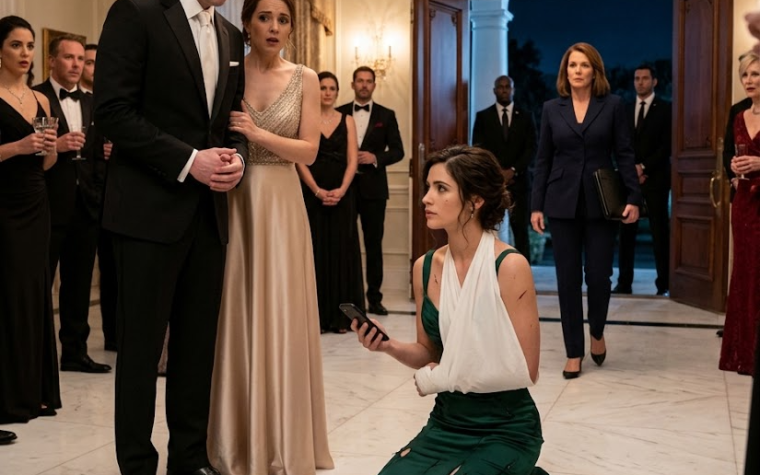
I opened the clutch slowly enough for Grant to understand that I wasn’t reaching for a tissue.
The microphone was warm in my other hand.
Two hundred people had gone silent, and somewhere behind Grant, a fork touched a plate with a tiny metallic click that sounded impossibly loud.
Grant stared at the cream-colored document I pulled from my clutch.
His face changed.
Brielle noticed.
“Grant?” she whispered.
He didn’t answer her.
I looked across the ballroom at the people who had watched him hold another woman’s hand onstage and speak about courage while his wife sat behind a column.
Then I looked at my husband.
“You told everyone tonight that you’re finished pretending,” I said into the microphone.
“So am I.”
Grant took one step toward the stage.
“Put the microphone down.”
His voice was low, but the microphone caught enough of it for the first few tables to hear.
I didn’t move.
“You also told me,” I continued, “that you and Brielle will be staying at Hawthorne House while I cooperate with your transition.”
A nervous murmur moved through the ballroom.
Brielle folded her arms as though she were trying to recover the confidence she’d had ten minutes earlier.
“This is inappropriate,” Grant said.
I almost smiled.
Inappropriate.
He had seated his wife at the back of his gala, put his mistress beside him, praised her from the stage, and announced his new beginning before telling me where I was expected to live.
But my response was inappropriate.
“You’re right,” I said.
“Property matters shouldn’t be decided at a charity gala.
They should be decided by documents.”
I held up the papers.
Grant’s eyes stayed fixed on them.
Brielle looked from him to me.
“What is that?”
That question wasn’t meant for me.
It was meant for him.
Grant’s silence answered more than he realized.
Hawthorne House had been part of my life before Grant was.
Years before our marriage, before his first major promotion, before the tailored suits and executive dinners and people returning his calls within minutes, I had acquired the property in my own name.
Grant knew that.
He had known it when we married.
He had known it when he moved in.
And he had known it every time he referred to Hawthorne House as “ours.”
I had never corrected him at dinner parties because I had never imagined I would need to.
Marriage had a way of turning precise legal language into casual pronouns.
Mine became ours.
His became ours.
The future became ours.
Until Grant decided the future belonged to him and Brielle.
The document in my hand was the record he had apparently convinced himself no longer mattered.
“Hawthorne House isn’t marital property,” I said.
“It wasn’t purchased during our marriage.
You didn’t buy it.
And putting your clothes in the closets didn’t put your name on the deed.”
Several people looked down immediately, suddenly fascinated by their napkins.
Grant climbed the first step toward the stage.
“We are not discussing this here.”
“You discussed our separation here.”
That stopped him.