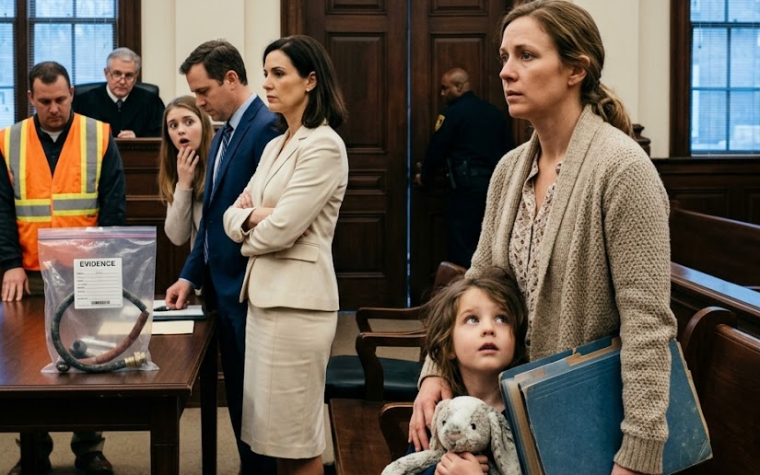
The judge set the paper down.
“You signed it.”
Nobody laughed now.
The consequences were not instant, and they were not theatrical.
The judge did not seize the restaurant from Michael on the spot.
No one dragged him from the room.
Real legal proceedings did not move like that.
What happened was more dangerous to a man who had built his confidence around controlling the story.
The court ordered expanded financial disclosure.
Records connected to the business accounts and transfers would be reviewed.
The disputed ownership and contribution evidence would be examined rather than dismissed as Michael had expected.
The old accident records and conflicting representations became relevant because they challenged the credibility of his claim that I had never functioned as part of the business.
And the financial discrepancies invited scrutiny far beyond the simple argument Michael had walked into court expecting to win.
Outside the courtroom, he caught up with me near the elevators.
Grace was beside me.
Michael’s attorney was several steps behind him.
“Evelyn.”
I kept walking.
“Evelyn, stop.”
I turned.
He looked older than he had that morning.
Not physically transformed.
Just stripped of the expression he had worn for years whenever he believed he controlled the room.
“You could have talked to me before doing this,” he said.
I almost laughed at the absurdity of it.
“I tried talking to you for twenty years.”
His eyes flicked toward Grace.
“This is going to destroy the restaurant.”
There it was.
Not an apology for calling me a pack mule.
Not an apology for erasing my work.
Not an apology for what he had said after the accident.
His first concern was still the restaurant.
I looked at him and finally understood something I had spent years refusing to see.
Michael had never believed my sacrifices were invisible.
He had seen them clearly.
He simply believed they belonged to him.
“The truth isn’t destroying it,” I said.
“The truth is describing it.”
The elevator doors opened.
I stepped inside with Grace.
Michael didn’t follow.
In the weeks that followed, the financial review uncovered enough inconsistencies to weaken his position significantly.
Transfers he had described as ordinary business activity were examined closely.
My historical contributions, deferred compensation, documented operational role, and economic interest all became part of the court’s evaluation of the marital estate and the restaurant.
Several former employees agreed to testify if needed.
Helen provided additional records.
Carlos found old photographs taken during staff events and renovation periods.
They did not prove ownership by themselves, but they destroyed the image Michael had tried to create of a wife who occasionally wandered in to carry boxes.
There I was behind the service counter during construction.
There I was standing with contractors beside exposed walls.
There I was in the kitchen with a clipboard while Michael was away at a community event.
There I was, again and again, inside the life he said I had never helped build.
Brittany stopped attending the hearings.
I never asked why.
Michael eventually changed tactics.