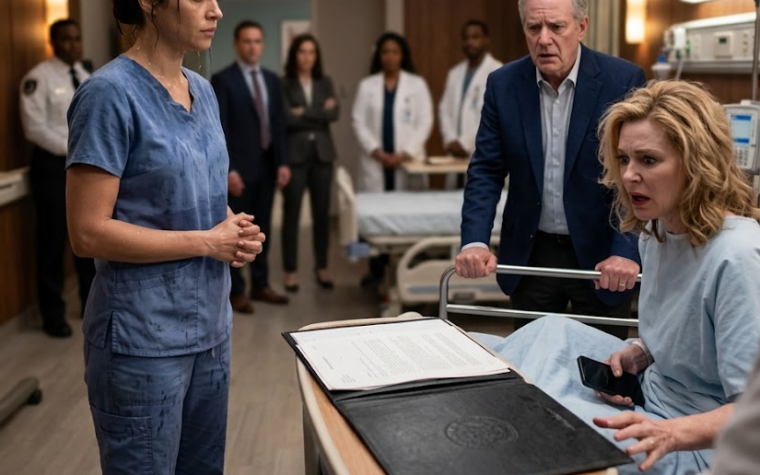
Grace opened the blue folder, and Michael went pale before the judge had read a single word.
I knew why.
He recognized the first page.
It was a copy of the hospital intake record from the industrial kitchen accident that had left the scar along my ribs and the burn down my arm.
The original had been filled out while I was barely conscious, drifting in and out beneath fluorescent emergency-room lights.
At the time, Michael had stood beside my bed and answered most of the questions for me.
Occupation?
He had said I wasn’t employed by the restaurant.
Relationship to the business?
He had said I was only his wife, occasionally helping when things got busy.
Location of injury?
That answer had changed depending on who was asking.
The judge adjusted her glasses and studied the page.
Michael’s attorney rose immediately.
“Your Honor, we object to any attempt to turn a property hearing into a collateral dispute over an old medical event.”
Grace remained calm.
“The medical event is not the issue by itself.
The representations surrounding it are.
Mr.
Carter has testified that Mrs.
Carter was never materially involved in operating the restaurant and had no ownership role.
These records are part of a larger chain of evidence showing otherwise.”
Michael laughed once, but there was no humor left in it.
“A hospital form doesn’t make her an owner.”
Grace turned one page.
“Correct.
Which is why we did not bring only a hospital form.”
She slid the next document forward.
It was a payroll ledger from the restaurant’s earliest years.
My name appeared on it.
Not once.
Not casually.
Week after week.
The amounts were small because, in those days, everything was small.
We had barely enough money to keep produce in the refrigerator and gas in the delivery van.
Michael and I used to sit at our kitchen table after midnight deciding which bills could wait until Friday.
But there it was in black ink: Evelyn Carter, hours worked, rate of pay, deductions.
Michael stared at the page.
“That’s bookkeeping,” he said.
“It doesn’t mean anything.”
Grace looked at him.
“Your bookkeeper signed it.”
Then she produced the bookkeeper’s sworn statement.
The courtroom changed.
Until that moment, Michael had treated the hearing like theater.
He had smiled, joked, leaned back, and spoken over people.
Now his shoulders pulled inward.
His attorney bent close to him and whispered something I couldn’t hear.
Brittany leaned forward from the row behind him.
“Michael?”
He ignored her.
The judge continued reading.
The statement came from Helen Morris, who had handled our accounts during the first nine years of the restaurant.
Helen wrote that I routinely worked opening shifts, managed supplier deliveries, supervised kitchen preparation, reconciled cash drawers, and participated in decisions about hiring, purchasing, and expansion.
She also wrote something Michael had apparently forgotten.
When the restaurant was struggling during its third year, Michael had asked Helen to stop issuing me formal paychecks.