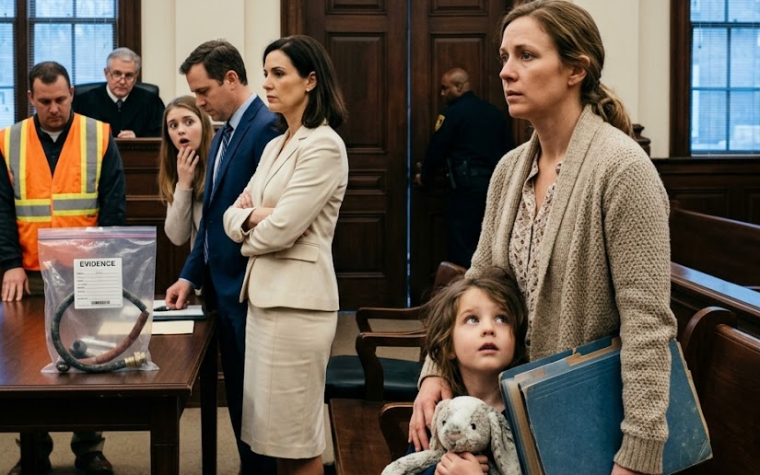
This time, I had an attorney beside me.
The later proceedings were slower and less dramatic than that first hearing.
Truth usually is.
There were depositions, expert reports, subpoenas, and months of careful review.
Evan denied the violence.
He blamed accountants for the transfers, software for the duplicate signature, and Marcus for the custody strategy.
Marcus, through separate counsel, denied knowing the full extent of Evan’s conduct.
The professional investigation continued independently, and he withdrew from every matter involving our family.
The authenticated recording could not be blamed on an accountant.
Neither could the hospital visit.
Neither could the messages.
Faced with the complete financial timeline and the risk of additional charges, Evan eventually stopped contesting the paternity he had privately acknowledged from the beginning.
The court made the custody arrangement permanent, with any future expansion of visitation conditioned on treatment, compliance, and professional evaluation.
The financial case ended with the estate restored to the marital property pool, the shell-company transfers unwound, and a settlement that gave my son and me stable housing without placing Evan in control of the trust.
The criminal and professional matters followed their own paths.
Some allegations resulted in formal charges; others remained part of the family-court findings.
Nothing happened as quickly as people imagine justice should happen.
But Evan could no longer decide which version of reality everyone had to accept.
Claudia sent one letter asking to see her grandson.
It contained six paragraphs about the Reed name and one sentence about what had happened to me.
I replied through my attorney.
Access would require respect for the court order, acknowledgment of the harm, and no attempt to undermine me as my son’s mother.
She did not answer for several months.
Vanessa returned the bracelet through counsel.
There was no apology attached.
I did not need one from her to know what the gesture meant.
She had entered the courtroom believing she was witnessing my defeat.
She left after discovering that Evan’s lies had included her too.
I sold the bracelet.
The money paid the deposit on a small office where I began taking forensic-accounting work again.
My first clients were not powerful developers or large firms.
They were women trying to understand accounts they had been told were too complicated for them.
I never promised to rescue anyone.
I showed them where to look.
Months after the hearing, I found the cream cardigan folded at the bottom of a drawer.
The marks it once covered were gone.
For a long time, I held it without moving.
Then my son began crying in the next room.
I left the cardigan where it was and went to him.
He was bigger now, strong enough to wrap his hand around one of my fingers.
He would not remember the courtroom, the red folder, or the people who discussed his life as though he were an asset to be controlled.
Someday, I would tell him the truth in words suited to his age.
I would tell him that his mother entered court without a lawyer, but not without evidence.
That power can shout, threaten, and hire people to smile on its behalf.
That truth often arrives quietly, organized by date, waiting inside a folder.
Most of all, I would tell him he was never the weapon used against me.
He was the reason the lies could no longer survive.