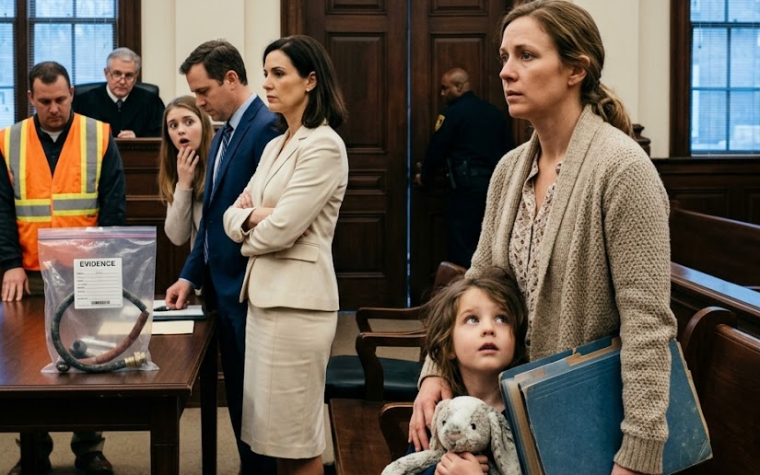
The judge’s voice remained level.
“Perjury is not made less serious by calling the truth complicated.”
Claudia rose from the bench behind him.
“This is absurd,” she said.
“My son has provided for that woman since the day she entered our family.”
The judge looked over his glasses.
“Sit down, ma’am, or leave the courtroom.”
Claudia sat, but she continued glaring at me.
She had perfected that expression during the first year of my marriage.
It was the look she used whenever I spoke about my career, my education, or the life I had before Evan.
She called me ungrateful when I kept my own bank account.
She called me disloyal when I returned to therapy after the pantry incident.
Once, at a family dinner, she had lifted her wineglass and said, “Some women marry into stability and then become addicted to being rescued.”
That morning in court, she finally understood I had not come to be rescued.
Vanessa sat beside her with my bracelet in her palm.
Evan had given it to me on our fifth anniversary.
After I left the estate, it disappeared from the locked drawer where I kept it.
Vanessa had worn it into court as a declaration: he chose me, you lost.
Now she studied the bracelet as though it might contain another secret.
The judge continued through the folder.
There were screenshots of Evan’s messages telling me I would never see our child again if I spoke about the injuries.
There was the photograph of the pantry door, cracked at shoulder height.
There was the statement from the nurse who had photographed my bruises and recorded that Evan repeatedly answered medical questions on my behalf.
There was also a copy of the hospital visitor log.
Evan had signed in under a false surname thirty-two minutes after sending Vanessa a message saying he was in another city for a business meeting.
Security footage showed him entering my room with Marcus’s custody documents tucked beneath his arm.
Marcus tried to exclude the footage.
The judge reserved a final ruling but allowed the certified visitor record to remain.
Then the judge reached the final black tab.
Behind it was a transaction summary I had prepared.
I had traced each transfer, listed its source, documented its destination, and matched it to the dates of Evan’s threats and court filings.
The sequence was unmistakable.
First, Evan moved the estate and liquid funds beyond my immediate reach.
Then he stopped deposits into the account I used for medical expenses.
Then Marcus delivered custody papers to my hospital room.
When I refused to sign, Evan filed an emergency petition portraying the financial isolation he created as proof that I could not support our child.
The last page was a single bank instruction bearing Evan’s electronic approval.
It directed the trust administrator to retain control of all assets allocated for our son if Evan obtained temporary custody.
The plan had never been temporary.
Custody was the key that gave Evan control of the trust.
Our son was not simply caught in the dispute.
Evan had made him the central mechanism of it.
For several seconds, the only sound in the courtroom was the soft movement of paper.
Then Evan stood again.
“She stole those records,” he said.
“She’s obsessed with me.
She has been planning this for months.”
I almost laughed at the last accusation.
Of course I had been planning.
I had planned every time I photographed a bruise instead of deleting it.
Every time I forwarded a bank notice to an account Evan could not access.
Every time I wrote down the date of a threat while he was still speaking.
Every time I pretended not to understand the shell-company statements he left open on his desk.
He had mistaken silence for confusion.
He had mistaken fear for surrender.
The judge ordered a recess.