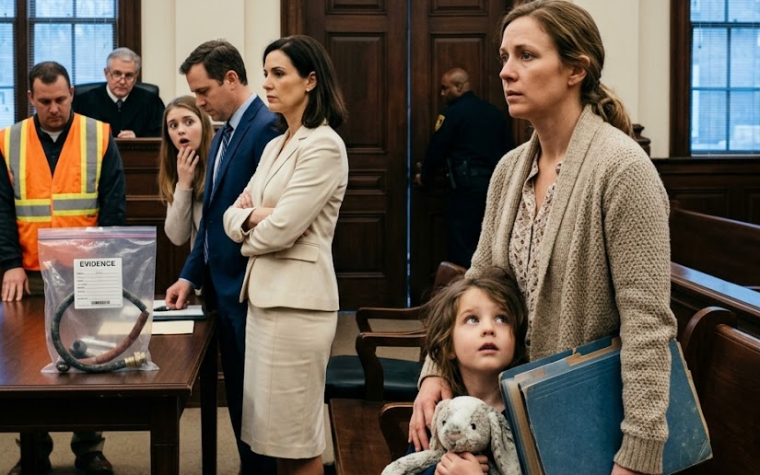
The settlement reflected the marital assets that could be established through the records and formal review.
Appropriate financial support and parenting arrangements were addressed through the legal process rather than dictated by Trevor or his family.
Our son remained at the center of my decisions.
I did not want to use him as leverage.
I did not want revenge.
I wanted stability, fairness and enough independence to build a life in which nobody could threaten my security with one cold word before sunrise.
Trevor eventually stopped trying to speak to me through his mother.
Our conversations became brief and mostly about the baby.
Months after that first morning, he once stood near me after an exchange and glanced at the navy suitcase in the back of Ruth’s hallway.
I had never bothered replacing it.
“You really had all those records before you left?” he asked.
“Most of them.”
He looked away.
“Why didn’t you say anything?”
I thought about the question.
Because for years I had explained myself constantly.
I explained why I was tired.
Why I needed help.
Why another dinner felt impossible.
Why a newborn did not sleep according to Trevor’s schedule.
Why moving into his parents’ estate was supposed to be temporary.
Why I wanted access to information about our own finances.
Every explanation had become another opportunity for someone to tell me I was overreacting.
So when the numbers began bothering me, I stopped explaining.
“I wanted facts before I spoke,” I told him.
Trevor gave a small nod.
There was nothing left to argue about.
Ruth’s blue house was never meant to be permanent either, but temporary felt different there.
Nobody used the word as a trap.
She helped with the baby when I had legal appointments.
I began rebuilding professional contacts.
Slowly, I remembered the part of myself that existed before the Hayes family decided my usefulness was measured by how quietly I served everyone else.
One afternoon, I opened my laptop at Ruth’s kitchen table while my son slept nearby.
For the first time in years, the spreadsheet in front of me belonged to work I had chosen.
Ruth set down a cup of tea.
“You look different,” she said.
“How?”
“Like you’ve stopped waiting for permission.”
I smiled.
The sentence stayed with me because she was right.
The morning Trevor asked for a divorce, he thought the most important thing in my hands was the baby.
He was right about that.
What he did not understand was what I had been carrying quietly in my mind for months: dates, numbers, missing statements, changed passwords, unexplained movements of money and the growing certainty that the story being presented around me did not match the records.
He thought I left the house with one suitcase.
In practical terms, I did.
But I also left with knowledge.
And knowledge, once supported by evidence and put in the hands of the right lawyer, changed the balance of power far more effectively than shouting ever could.
I never got the dramatic apology people imagine should come at the end of stories like mine.
Diane never admitted she had treated me like staff.
Trevor never confessed that he had underestimated me.
I did not need either one.
The court did not require their remorse.
It required records.
My son grew.
My life became quieter.
I returned to work gradually and built routines that belonged to us instead of the Hayes household.