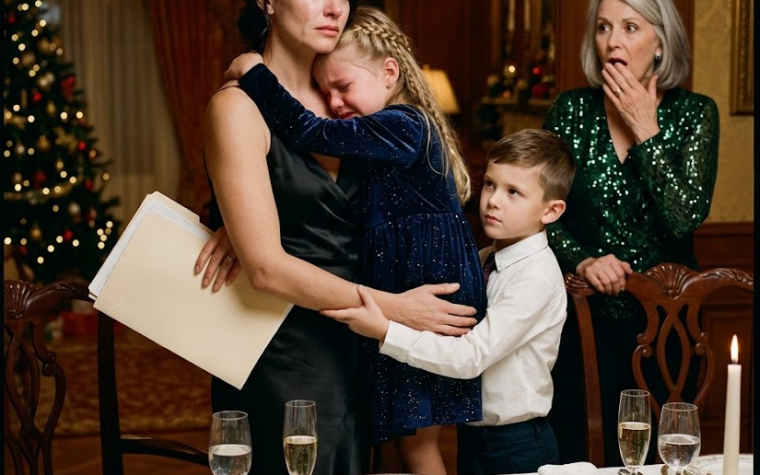
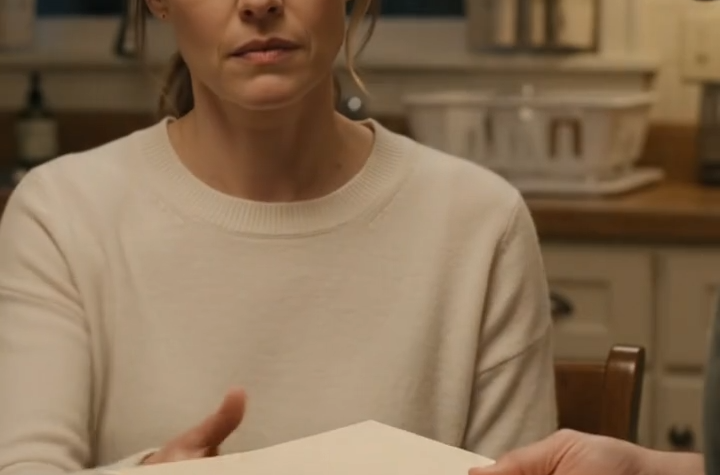
The folder opened with a dry crack, and every adult in the room leaned forward.
Mom laid the signed deed on the table first.
The creditor who had been smiling picked it up, read the first lines, and frowned.
He turned the page, then looked toward the four small bags standing beside the front door.
“You sold it?” he asked.
Mom placed a second sheet beside the deed.
It listed every debt my father had left behind.
Next came the receipts, one after another, arranged in a straight line.
“The house has been sold,” she said.
“The debts will be paid in full.”
The man stared at her.
He had expected a frightened widow to surrender the property.
He had not expected her to sell it herself, settle every account, and deny him the pleasure of taking it from us piece by piece.
“And where will you go?” he asked.
Mom turned from him and held out her hand.
Lucy took it first.
I caught the edge of Mom’s sleeve.
Tony picked up his bag, trying to look older than five, and Matthew clung to her skirt.
“They are coming with me,” she said.
One creditor gave a short, disbelieving laugh.
“All four?”
Mom looked at him steadily.
“All four.”
Her relatives argued with her outside the house.
They reminded her that she was young, that she was still beautiful, that no sensible man would marry a woman carrying four children who were not hers.
They said she was throwing away her future.
Mom listened without raising her voice.
Then she gathered us together and walked away from the only home we knew.
It was 1978.
We went to the outskirts of Galveston, Texas, where a distant cousin of Mom’s named Teresa lived near the market.
We called her Aunt Teresa, although the exact line connecting the two women was too complicated for us to understand.
Aunt Teresa was a widow.
She cleaned fish and sold it at the market, and poverty had bent her life into a narrow shape.
Her house was made of tin and wood, patched wherever rain had found a way inside.
Five people were already too many for its rooms, but she opened the door and made space for six.
That first night, we slept pressed close together on old mats.
The roof ticked in the wind.
Somewhere nearby, water dripped steadily into a metal basin.
Tony whispered that he missed Dad’s chair.
Lucy told him to sleep.
Matthew crawled against Mom and tucked his face beneath her chin.
Mom lay awake until morning.
Aunt Teresa knew someone connected to the general hospital.
Jobs were scarce, favors were expensive, and poor people often paid with whatever they had.
She gave three fat hens to an acquaintance to secure Mom a position as a cleaning assistant.
Those hens were valuable.
They could have provided eggs or meals for weeks.
Aunt Teresa handed them over without complaint.
Mom began work before sunrise.
Every morning at three-thirty, she rose quietly, washed in cold water, pinned back her hair, and walked to the hospital.
Her first duty was to boil water for patients who woke early and needed to wash their faces, prepare milk, or make tea.
Some patients gave her coins.
She saved them for notebooks, pencils, erasers, and school fees.
At six, she hurried home to prepare breakfast.
She woke us, checked our clothes, divided whatever food we had, and sent us toward school.
At seven, she returned to the hospital.