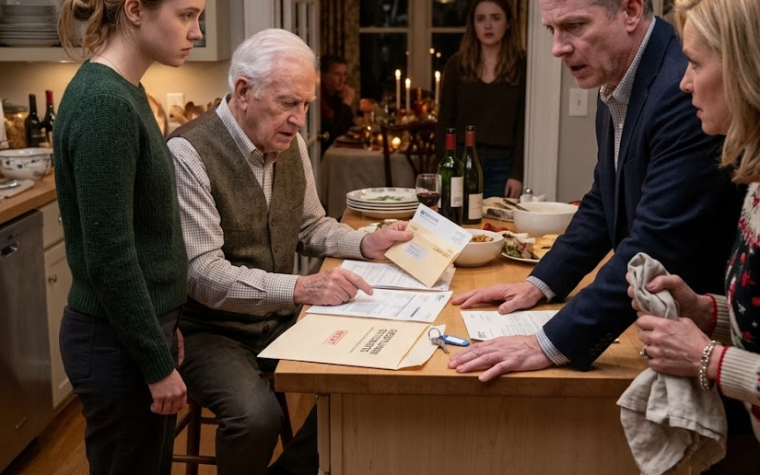
The room seemed to shrink around the sound of its pages unfolding.
Dad had given me the sealed leather folder two years before his death.
He did not tell me what was inside.
He only repeated the lesson he had taught me when I was twelve.
Paper remembers what people try to forget.
He instructed me to keep the folder somewhere safe and open it only if anyone ever told me I had no right to ask questions.
I had obeyed him.
When Diane first said the estate was none of my concern, I opened it.
Inside was an original, signed copy of the Jameson family trust.
Every page carried Dad’s initials.
The final page bore an embossed notary seal and the signatures of two witnesses.
The version Diane filed with the court contained eleven pages.
Dad’s original contained fourteen.
Three pages were missing from hers.
The judge placed the documents side by side.
The first missing page required the temporary trustee to provide every beneficiary with statements, account numbers, and transaction records.
The second named me successor trustee if Diane failed to provide an accounting or attempted to conceal estate property.
The third contained a fraud clause.
Any beneficiary who knowingly forged a document, concealed an asset, or submitted a false claim against another beneficiary would forfeit the discretionary portion of that beneficiary’s inheritance.
The forfeited share would return to the trust for distribution to the remaining lawful beneficiary.
Simon read the clause over the judge’s shoulder from several feet away.
His face emptied.
“This is fake,” he said.
I turned the original so the court could see the seal.
The judge examined the paper, the signatures, the staple impressions, and the notary registration attached to my filing.
Diane rose again.
“Her father would never have done this.”
“Your husband signed every page,” the judge said.
“He was sick.”
“The trust was executed four years before his illness.”
“He was manipulated.”
“By whom?”
Diane looked at me.
“By her.”
I almost laughed, but there was nothing funny left.
Four years earlier, I had been finishing school and working two jobs.
I had not known the trust existed.
Dad had prepared it because he understood his family more clearly than I had wanted to admit.
The judge called a recess and ordered both sides to remain available.
The bailiff collected the disputed waiver.
The clerk retrieved the archived docket, courtroom access records, and the original video certification from my earlier testimony.
During the recess, Diane walked toward me.
The bailiff immediately stepped between us.
My mother stopped several feet away.
“You planned this,” she whispered.
“No.”
“You let us come in here and embarrass ourselves.”
“You filed the waiver.”
“You could have warned me.”
“I asked for the statements six times.”
Her eyes filled with anger, not regret.
“Your brother needed that money.”
“So you forged my name.”
“We did what the family required.”
Behind her, Simon paced beside the defense table.
He kept checking his watch, as though it could take him backward to the moment before he laughed.