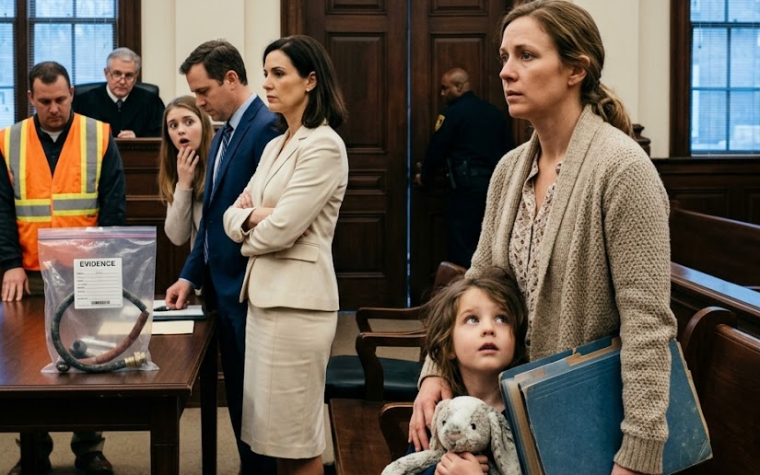
“Calls from whom?”
The attorney placed the page in front of them.
His wife did not touch it.
The calls had come from her number.
In the first, she had asked how quickly a future beneficiary could take control of property after a transfer.
In the second, she had asked whether a spouse automatically gained rights to a house received through a family trust.
In the third, she had asked whether the beach house could be refinanced immediately after ownership changed.
The attorney had refused to discuss confidential details each time.
He had logged the calls and informed me only after I asked him to review every recent contact related to the trust.
My son read the page twice.
Then he turned toward his wife.
“You called him?”
She lifted her chin.
“I was gathering information.”
“For what?”
“For our future.”
“It wasn’t your future to plan,” I said.
She looked at me with open contempt now.
“You were going to leave it to him.”
“I was considering leaving him a protected interest in it after my death.”
“Which means it was going to be his.”
“No.
It means I trusted him to respect something our family had preserved for decades.”
My son’s voice became quieter.
“What did you change?”
The attorney turned another page.
The original trust had named my son as successor trustee.
If I became incapacitated or died, he would have gained authority to manage the property.
Eventually, he might have received it outright.
The amendment removed him as successor trustee.
An independent fiduciary would now manage the trust if I could not.
Any future benefit my son received would remain protected, distributed only under conditions I controlled, and kept separate from anyone else’s debts, contracts, or marital claims.
His wife stared at the attorney.
“You’re saying I can never own it.”
“I’m saying you never owned it,” he replied.
The room went silent.
I watched my son process the distinction between expecting something and possessing it.
For years, I had allowed him to use the beach house whenever it was empty.
He had a key.
He knew the alarm code.
He had spent long weekends there with his wife and friends.
I had mistaken access for gratitude.
They had mistaken access for surrender.
The attorney removed a small envelope from the folder.
“This is formal notice that all keys must be returned within forty-eight hours.
The alarm code has been changed.
No one may enter the property without written permission from the trustee.”
My son’s head snapped up.
“You changed the locks?”
“I changed the authority,” I said.
“The locks simply reflect it.”
His wife laughed again, but this time the sound broke in the middle.
“We already made plans.”
The attorney looked at her.
“What kind of plans?”
She realized too late that she had said too much.