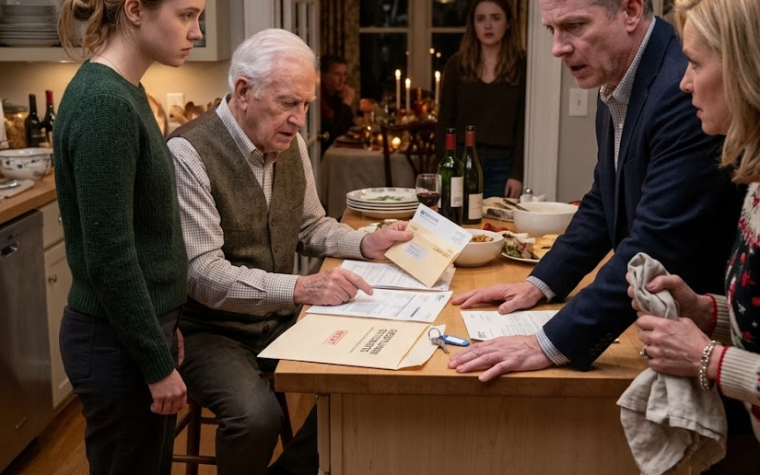
My mother began crying again.
This time, I did not rush to comfort her.
Months passed before my children stopped asking whether Thanksgiving had been their fault.
That was the consequence I cared about most.
Not Richard’s job.
Not Vanessa’s anger.
Not my parents’ embarrassment.
My son had carried the expression from that room home with him—the careful, embarrassed look of a child trying to understand why adults who claimed to love him had enjoyed watching him hurt.
So I worked on that damage the way I worked on everything important: patiently.
We built new traditions.
Smaller ones.
Quieter ones.
No performances.
No cameras waiting for gratitude.
No invisible ranking system hidden beneath ribbons and wrapping paper.
The following holiday season, my daughter helped me place ordinary gifts beneath a small tree in our living room.
Nothing extravagant.
She picked up one box, checked the tag, then another.
Finally she looked at me.
“Everybody has one?”
“Yes.”
She smiled.
That simple question told me more about the previous year than any argument with my parents ever had.
My son came in carrying mugs of cocoa and complained that his sister was shaking boxes.
She denied it while holding one directly beside her ear.
They started laughing.
I stood there listening to them and realized I no longer missed the giant dining room, the perfect garland, the expensive perfume, the staged photographs, or the exhausting effort of pretending humiliation was tradition.
My family had spent years thinking money was power.
Richard thought status was power.
Vanessa thought approval was power.
My parents thought exclusion was power.
But the only power I had needed that Thanksgiving night was the ability to stand up, take my children’s hands, and leave.
The investigation would have gone forward whether they had treated us kindly or cruelly.
Richard’s records had already created his professional problem.
What my family controlled was whether they would still have a place in our lives when the truth arrived.
They made that choice before I ever sent the text.
I had simply stopped protecting them from its meaning.
Sometimes I still remember the exact sound of the fireplace popping behind my children while nobody defended them.
But I remember something else now too.
My son’s hand in mine as we walked out.
My daughter breathing easier once the front door closed behind us.
And the quiet kitchen later that night, with the final report beneath my palm and my phone vibrating beside it.
For years, my family had called my restraint weakness.
They were wrong.
Restraint was the reason the investigation stayed clean.
It was the reason Richard could not credibly turn his own documented problems into a story about Thanksgiving revenge.
And it was the reason, when everything finally broke open, I did not need to shout.
I had already said the only thing that mattered.
We are not your family joke anymore.