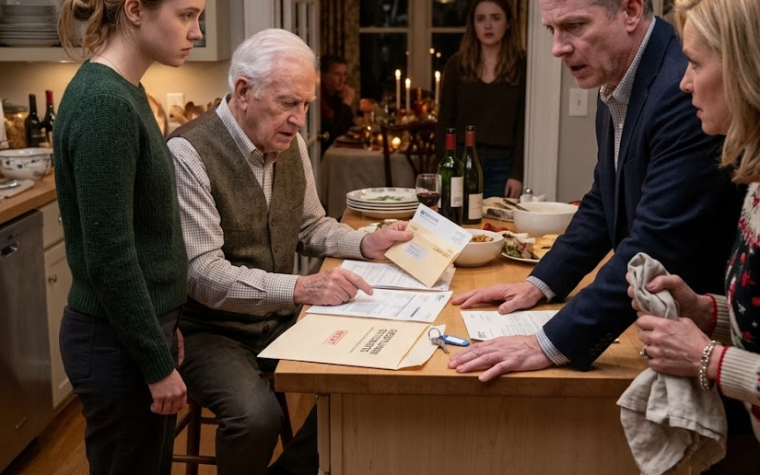
Their attorney read in silence.
Mom looked at me instead.
“Your grandmother poisoned you against us.”
“Grandma documented what you did.”
“We gave you a home.”
“You told me I should be grateful you kept me.”
For the first time, Mom seemed to hear her own words repeated without the protection of a Christmas audience.
She looked toward Dad, but he was staring at the questionable signature on the check.
Sarah pushed her chair back.
“So what happens to my wedding?”
No one answered immediately.
That was the center of her world.
Not the missing money.
Not the lies.
Not the possibility that our parents had signed Grandma’s name.
Her wedding.
I spoke calmly.
“You have the wedding you can afford.”
She stared at me as though I had slapped her.
“You’re really going to punish me for what Mom and Dad did?”
“I am refusing to pay for you.
That is not punishment.”
Their attorney asked for a private recess.
When the meeting resumed, the threats were gone.
My parents offered to repay a portion of the withdrawals if I signed a confidentiality agreement and released all claims.
The amount excluded several transactions they labeled shared family expenses.
I declined.
Dad’s face darkened.
“You would drag your own parents through court?”
“You were willing to disown me over a wedding bill.”
He had no answer.
Negotiations continued for six weeks.
Miriam prepared the complaint while my parents’ attorney pushed them toward settlement.
The disputed signature created the greatest pressure, but the written admissions and bank history mattered too.
Eventually, my parents agreed to repay the documented account losses, contribute toward my legal and forensic expenses, and provide a formal accounting.
They also signed a non-disparagement agreement prohibiting them from telling relatives or employers that I had stolen, manipulated Grandma, or promised to finance Sarah’s wedding.
They did not admit intentional wrongdoing in the settlement.
They did, however, refinance their house to fund it.
Sarah’s $93,000 wedding disappeared almost overnight.
The vineyard reservation had only been tentatively held.
Without my money, the required deposit was impossible.
The imported flowers, string quartet, and glass tent were canceled.
Sarah and Mark eventually married in a small hotel ballroom with fewer than sixty guests.
I was not invited.
For once, exclusion felt less like punishment and more like peace.
Several months after the settlement, Mom mailed me a letter.
She wrote that she hoped time would soften my heart.
She described the stress the dispute had caused her, the embarrassment of changing Sarah’s wedding, and the pain of relatives asking questions.
She did not mention the writing academy.
She did not mention the years I worked through college.
She did not mention Grandma’s money except to say that families sometimes made complicated financial decisions.
I placed the letter in the gray box.
Dad never apologized.
Sarah sent one message accusing me of buying justice because I could afford a lawyer.
I did not respond.
Aunt Marlene and I spoke occasionally.