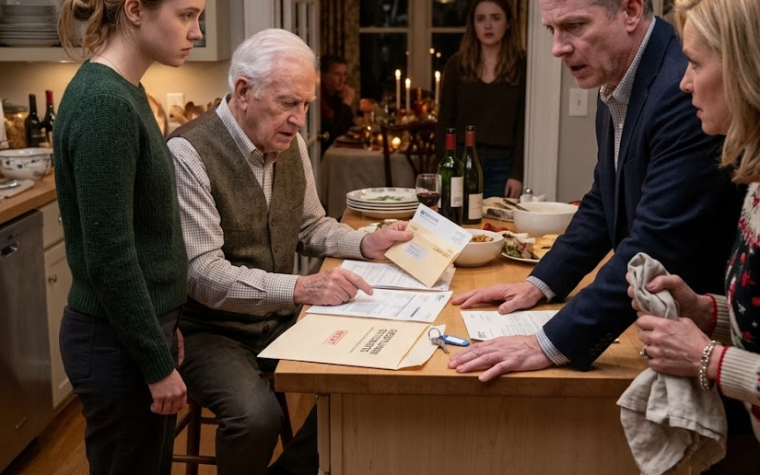
What Ethan lost was the belief that his parents would protect his child simply because she was theirs to love too.
That loss was harder than money.
But something else replaced it.
Clarity.
A year after the cookout, Lily’s cheek had healed far better than I had feared during that first terrible night.
A faint change in the skin remained visible in certain light, and we continued following her doctors’ advice, but she was once again the fearless little girl who reached for toys without wondering whether an adult might punish her for it.
One summer afternoon, Ethan and I took her to a park.
A little boy left a red truck in the sandbox and ran toward the swings.
Lily looked at the truck.
For one instant, my entire body remembered Robert’s patio—the scrape of Vanessa’s chair, the ceramic mug, the scream.
I had to stop myself from rushing forward.
Lily picked up the truck, examined one wheel, and set it gently back in the sand.
The little boy returned.
Instead of shouting, he sat beside her and showed her how the back opened.
Within seconds they were playing together.
Ethan stood next to me watching them.
“She doesn’t remember it the way we do,” he said.
I nodded.
That became the thing I was most grateful for.
For months, I had imagined justice as the moment Vanessa was exposed.
Then I imagined it as a court order, a criminal consequence, or a civil settlement.
Those things mattered.
They created boundaries.
They paid for care.
They made it harder for anyone to rewrite what happened.
But none of them became the final scene in my mind.
The final scene was Lily in that sandbox.
Safe.
Curious.
Unashamed.
Still willing to reach toward the world.
My father had told me on the night of the hospital that people who were rewriting events depended on everyone else becoming confused, frightened, or tired.
“Move clean,” he had said.
At the time, I thought he meant legal strategy.
Later I understood it differently.
We did not need to become crueler than the people who had hurt us.
We did not need screaming matches, threats, or revenge.
We needed records.
Boundaries.
Witnesses.
Patience.
And the willingness to stop protecting people who had refused to protect a two-year-old child.
The neighbor’s camera did not destroy Ethan’s family.
It simply prevented them from hiding what they had already done.
And in the end, the most important thing we rebuilt was not their reputation, their approval, or their idea of family.
It was Lily’s sense that home was the place where the adults around her would keep her safe.