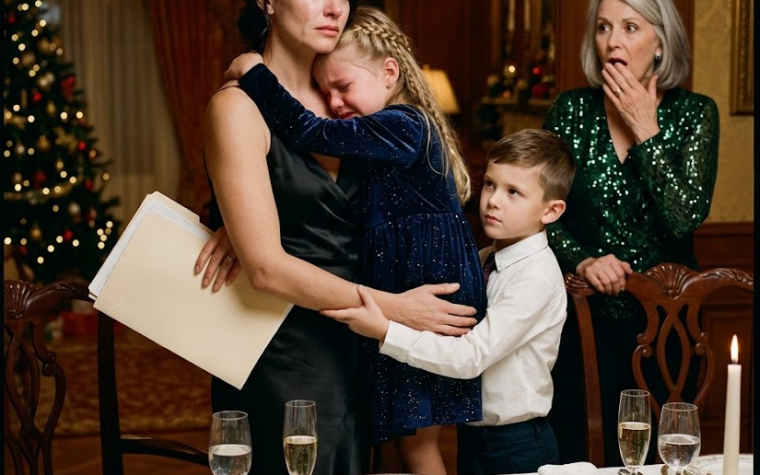
They saw the blood.
They watched him lock the door.
They applauded anyway.
At the first court hearing, my father entered wearing a dark suit and the expression he used at school board meetings.
He expected people to move aside for him.
Instead, a bailiff directed him where to stand.
His attorney argued that he had deep community ties and no criminal history.
The prosecutor answered by describing Clara’s injuries and playing the audio of her crying through the glass.
The judge issued a strict no-contact order covering both Clara and me.
My father was forbidden from approaching our home, her school, or the hospital where she received follow-up treatment.
For the first time in my life, his authority stopped at a line someone else had drawn.
The school board scheduled a public termination hearing after completing its investigation.
My father attended with counsel.
He claimed that stress, alcohol, and family conflict had distorted his judgment for a single moment.
The superintendent responded with a timeline.
The kick was one decision.
Dragging Clara to the door was another.
Shoving her outside was another.
Locking the door was another.
Preventing me from reaching her was another.
Allowing the guests to continue recording was another.
There had been dozens of moments when he could have stopped.
He chose cruelty each time.
The board voted unanimously to terminate him.
When the decision was read, my father finally looked frightened.
Not because he understood what he had done to Clara, but because the title he had built his identity around was gone.
The criminal case continued for months.
His attorney challenged the recordings, the medical findings, and the length of time Clara had remained outside.
Digital analysts verified the files.
Doctors testified about the risk posed by cold exposure.
The guest who had provided the longest video described the room’s laughter in detail.
My brother was called as a witness.
Under oath, he could no longer hide behind jokes.
He admitted recording Clara.
He admitted making the remark about strong grandchildren.
He admitted that he never attempted to unlock the door.
When asked why he had laughed, he said he had been following the mood of the room.
The prosecutor looked at him for a long moment.
“That room contained an injured eight-year-old child,” she said.
“Why was cruelty the mood?”
He had no answer.
Faced with synchronized videos, medical records, witness testimony, and his own shifting explanations, my father eventually pleaded guilty to child abuse and unlawful restraint.
The agreement spared Clara from testifying in open court, which mattered more to me than any dramatic trial.
At sentencing, I read a statement.
I did not call him a monster.
That word would have allowed everyone to imagine that he was something rare and unrecognizable.
I described him accurately.
He was a respected man who believed respectability would protect him.
He was a grandfather who confused fear with obedience.
He was an educator who punished tenderness because it reminded him that cruelty was a choice.
Then I told the judge what Clara had said in the hospital.
“I’m sorry, Mommy.”
My voice broke only once.
“My daughter believed she needed to apologize for being kicked, humiliated, and left in the snow.
That belief is the injury that will take longest to heal.”
The judge imposed jail time, supervised probation, mandatory treatment, and a long-term protective order.