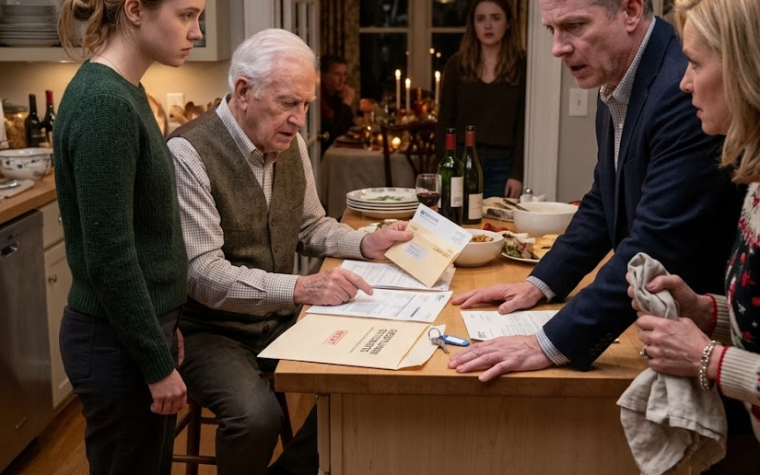
They still had income.
They still had assets.
They still had choices.
What they no longer had was automatic access to mine.
My father disagreed.
By Monday afternoon, he was at my front door.
I saw him through the camera before he knocked.
His shoulders were rigid.
My mother stood behind him clutching her handbag with both hands.
Emma was upstairs watching a movie.
I opened the door but did not invite them in.
“You need to fix the accounts,” Dad said immediately.
“No.”
“We can discuss the other issue later.”
“The other issue?”
He glanced toward my mother.
“The paperwork.”
“My adoption?”
Mom flinched at the word.
I noticed that.
I had spent three weeks saying it quietly in my own mind, trying to understand how one legal fact could suddenly change the shape of an entire childhood.
My mother still seemed unable to say it at all.
“We never thought of you differently,” she said.
I almost admired the certainty in her voice.
Then I opened the folder I had carried to the doorway.
“Do you remember Emma’s fourth birthday?”
Mom frowned.
“What does that have to do with anything?”
“You promised to come.
You canceled because my sister’s daughter wanted to go shopping.”
“That’s ridiculous.
There must have been more to it.”
“Her fifth birthday?”
No answer.
“You arrived two hours late because you were watching my sister’s children.”
Dad folded his arms.
“We help where we’re needed.”
“And Easter?”
“That was poor judgment,” he said.
“No.
Poor judgment is taking the wrong highway.
You looked at three children and decided which two were worth putting into the car.”
My mother’s face hardened.
“Your sister’s children are younger.”
They weren’t.
One was eight.
The other was seven.
Emma was six.
I waited.
Mom realized what she had said.
Then she tried again.
“They had more things with them.”
“There were empty seats.”
Her eyes flickered.
That detail had come from Mrs.
Donnelly, who had seen the SUV leave the pickup lane.