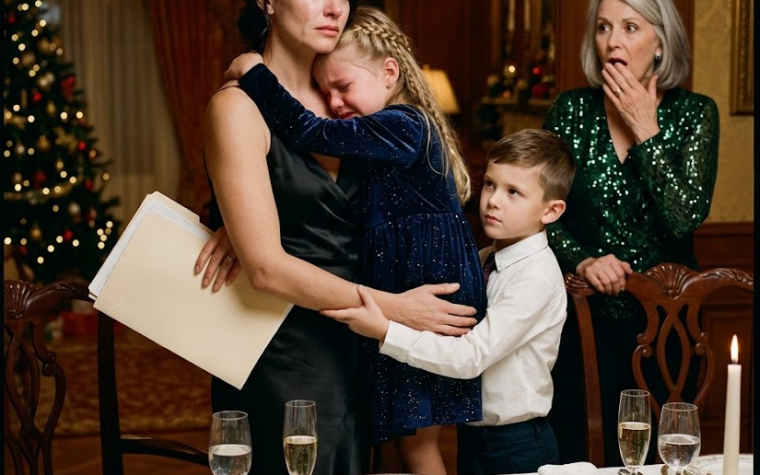
Leonard had looked through the glass.
Julia saw him.
He saw her lift one hand.
And he had said, “Tell her I’m unavailable.”
In the letter, Julia described waiting forty minutes.
She described watching men in suits leave the room laughing while Leonard remained inside, congratulating himself on the largest deal of his career.
She had left without telling him.
A week later, she mailed a letter to his old apartment.
It was returned because he had already moved into the Gold Coast penthouse.
She called his office twice, but by then Leonard had instructed his staff not to put personal calls through during working hours.
After that, Julia stopped trying.
I told myself you had made your choice, she wrote.
Maybe I was proud.
Maybe I was afraid you would look at our baby the way you looked at anything that interrupted your plans.
I could survive that look.
I could not risk Isabella seeing it.
Leonard pressed his thumb against the paper until it hurt.
His communications director shifted near the door.
“This is painful,” she said carefully, “but it still does not establish paternity.”
Leonard read on.
Julia had enclosed copies of Isabella’s birth records and several photographs.
In one, Julia stood beside a hospital window holding a newborn wrapped in a yellow blanket.
In another, Isabella was perhaps three years old, asleep with the rag doll tucked under her chin.
The doll had been made from fabric cut from one of Julia’s old dresses.
At the bottom of the folder was a hospital consent form authorizing a paternity test if Leonard ever came forward.
Julia had signed it six months before her death.
The final paragraph was shorter than the rest.
I am not asking you to rescue her with money.
Isabella needs someone who stays after the room empties.
She needs someone who listens when there is nothing to gain.
Should you ever meet her, do not promise to be her father because you feel guilty.
Become her father only if you are prepared to return tomorrow.
Leonard finished the letter.
For several seconds, no one spoke.
Then Isabella appeared in the doorway.
She did not enter.
She stood with the doll hanging from one hand and studied Leonard’s face.
“Did you know my mom?” she asked.
Leonard looked at the photograph of Julia by the river.
“Yes.”
“Were you nice to her?”
His communications director looked down.
Sister Teresa remained completely still.
Leonard could have softened the answer.
He had spent his career turning damage into language that sounded less damaging.
He did not do it.
“Not when it mattered most.”
Isabella considered this.
“Did you make her sad?”
“Yes.”
The child tightened her grip on the doll.
Leonard felt an urge to explain the meetings, the pressure, the years of work, and the fear that slowing down would return him to the poverty he had spent his life escaping.
None of it belonged in the room.
“I’m sorry,” he said.
Isabella looked at Sister Teresa, uncertain what to do with an apology from a stranger.
Then she asked, “Are you the man in the picture?”