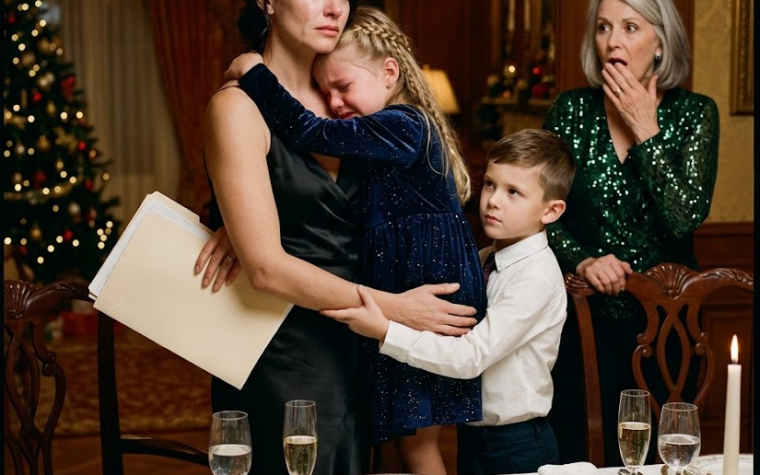
You stole medication.
You poisoned your child.
Then you weaponized his mother’s grief to protect yourself.”
He received a sentence that ensured he would spend most, and likely all, of the rest of his life in prison.
The hospital issued a formal apology and accepted responsibility for security failures, the unverified chart entry, and the audit delay that left the truth buried for six years.
A settlement paid the debts Daniel had left behind and funded stronger access controls in the neonatal unit.
I asked for one additional condition.
Liam’s medical record had to be corrected completely.
The false genetic diagnosis was removed.
The amended file stated that his death resulted from deliberate poisoning and that his mother had not caused or contributed to it.
It was a sentence no grieving parent should ever need written down.
Still, I requested a certified copy.
Months later, I returned to the hospital alone.
Dr.
Ellis met me near the NICU hallway and handed me a sealed envelope containing the corrected record.
The corridor still smelled like sanitizer.
An elevator chimed in the distance.
For an instant, my body prepared to collapse into the past.
Then I opened the envelope.
Liam’s name appeared at the top of the first page.
Beneath it was the truth Daniel had tried to erase.
I carried the record to the small chapel where Daniel and I had once begged for a miracle over cold vending-machine coffee.
The room was empty.
I sat in the last row and placed the document beside the only photograph I had brought: Liam’s tiny hand wrapped around my finger.
“I’m sorry it took so long,” I whispered.
The guilt did not vanish in one dramatic moment.
It loosened slowly.
In therapy, I learned to separate grief from blame.
I learned that loving Liam had never required me to punish myself.
I began driving past the hospital without changing streets.
I stopped holding my breath whenever I saw a blue H sign.
On Liam’s seventh birthday, I bought a small tree and planted it in a community garden outside Portland.
I pressed the soil around its roots with both hands.
For years, Daniel’s accusation had been the loudest sentence in my life.
Now another sentence had replaced it.
It was not your fault.
The words did not bring Liam back.
They brought me back.