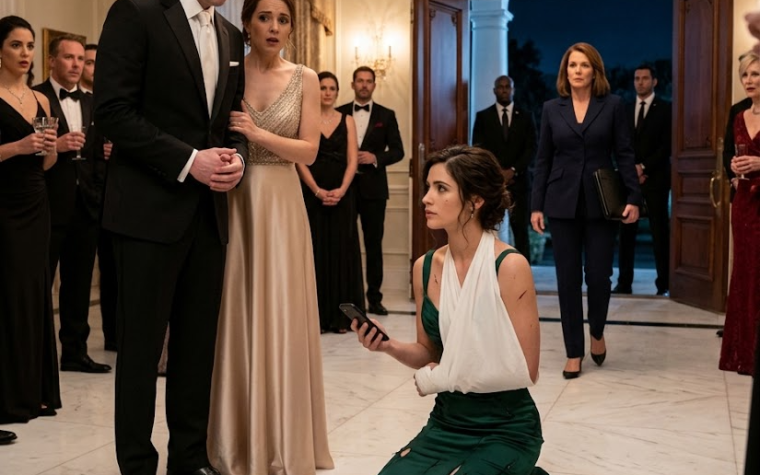
Someone had either entered my office, accessed restricted medical information, or placed an observer close enough to study me.
The board’s counsel examined the dates.
“Where did you obtain this version?” he asked.
“It was in the folder you left at my seat.”
“This memorandum was not supposed to be included.”
The director turned sharply toward him.
That was the first fracture.
Until then, they had presented themselves as a single body acting out of sober necessity.
With one sentence, the counsel revealed that there were documents the full board had not been meant to see.
I looked around the table.
“How many of you read the memorandum before voting to convene this meeting?”
Only three hands rose.
The remaining directors shifted in their chairs.
One woman near the end of the table removed her glasses.
“We were told an employee had reported seeing President Stanley in severe physical distress.”
“When were you told that?” I asked.
“Yesterday morning.”
Ethan had seen me after midnight.
The timing settled over the room like dust.
The director spoke quickly.
“The witness may have reported an earlier incident.
There is no conspiracy here.”
“Then identify the witness.”
“Confidentiality exists for a reason.”
“Yes,” I said.
“Usually to protect the vulnerable.
Not the powerful.”
I nodded to Ethan.
He broke the seal on the access log.
For years, Stanley Corporation had relied on electronic badges to record movement through the executive floors.
Cleaning staff used scheduled service codes rather than individual executive credentials.
Ethan knew the system because he had spent months working around it.
He also knew its weakness: when a cleaning route was changed manually, the alteration remained visible in the service history even if the printed schedule was replaced.
His route had been changed at 6:42 p.m.
on the night he found me.
The original route assigned him to floors thirty-one through thirty-four.
The revised route sent him directly to the top floor after midnight, even though my office was marked as restricted.
The authorization came from executive security.
The request, however, had originated from the director’s office.
He leaned back.
“My staff schedules cleaning all the time.”
“Your office does not supervise cleaning,” I said.
“A clerical error proves nothing.”
“Then perhaps the earlier entries will.”
Ethan placed three additional pages on the table.
During the previous week, the same office had requested temporary suspension of the motion alert outside my private suite on two evenings when I stayed late.
The requests were described as maintenance tests.
No maintenance work had been performed.
The director’s confidence thinned.
“You are relying on the interpretation of a janitor.”
Ethan finally spoke.
“No, sir.
She’s relying on timestamps.”
His voice was calm, which made the director’s anger appear louder.
“You should be careful,” the director said.
“A temporary contract will not protect you when this performance ends.”