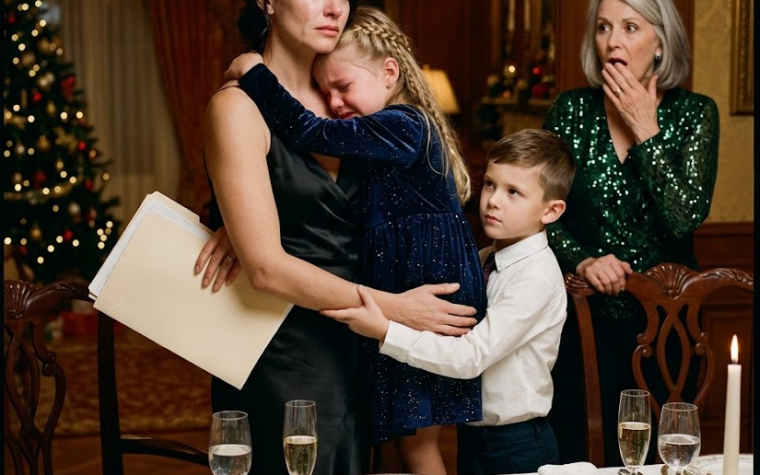
I left with my children exactly as I had entered—with four hands holding mine.
Ethan followed us to the hotel lobby but stopped when I raised my palm.
“Please,” he said.
“Just tell me where you live.”
“No.”
“They are my children.”
“They may be biologically yours.
That does not make you safe yet.”
His face tightened, but he nodded.
“What can I do?”
“Take the test.
Tell the truth.
Stop letting your father make decisions for you.”
Three days later, Ethan gave his sample at the independent laboratory my attorney selected.
The children’s samples were collected separately with me present.
The results arrived the following week.
The report confirmed that Ethan was their biological father.
He read it in my attorney’s conference room.
Victor was not invited.
Ethan pressed both hands against the table and bowed his head.
For several minutes, he said nothing.
Then he asked for photographs.
I showed him one from their birth.
Four tiny babies lay beneath hospital blankets, their faces red and furious, while I sat behind them looking more frightened than I had ever felt.
Ethan touched the edge of the photograph.
“You did this alone.”
“I had help from people who chose to show up.”
The distinction landed exactly where I intended.
Victor responded through lawyers.
He threatened to enforce the agreement, demanded confidentiality, and suggested that the Harrison family might pursue custody rights if I continued causing public disruption.
My attorney answered with the original uncashed check, the certified delivery records, the coercive agreement, and notice that the children’s rights could not be purchased before Victor knew they existed.
She also reminded him that custody courts examined conduct, stability, and attempts to conceal a parent’s identity.
The threats stopped.
Ethan refused to let Victor’s legal team represent him.
He hired independent counsel and revoked every authorization that allowed his father to control his personal affairs.
Then he moved out of the family estate.
He did not come to my home demanding forgiveness.
He did not arrive with expensive gifts or promises that money could repair time.
He began with supervised visits in a quiet family center.
The first visit was painful.
The children stared at him.
Ethan brought four elaborate toys, each wrapped perfectly.
They ignored the toys and asked why he had never attended their birthdays.
He looked at me before answering.
“I didn’t know about you,” he said.
“But I also did not work hard enough to find your mom.
I believed something because believing it was easier.
I am sorry.”
One child asked, “Are you leaving again?”
Ethan’s eyes filled.
“Not unless your mom tells me to.”
I almost smiled.
Almost.
Over the next several months, he learned that fatherhood was not a dramatic declaration in a ballroom.
It was arriving on time.
It was remembering which child hated peas, which one needed the hallway light left on, which one became quiet when frightened, and which one asked impossible questions at bedtime.