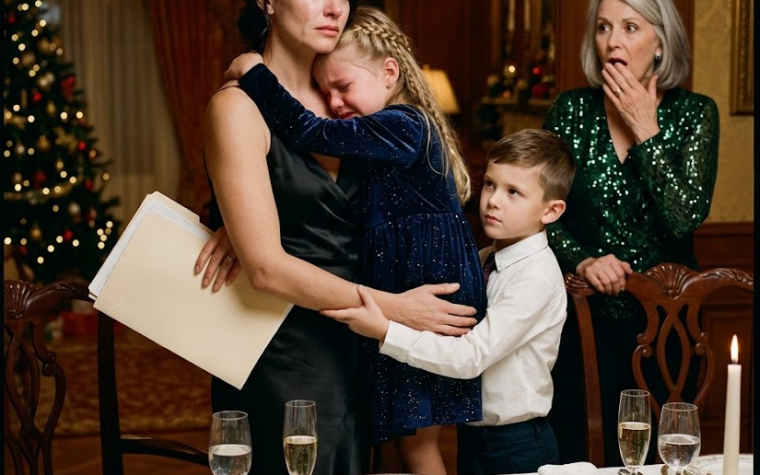
The first frame loaded slowly, one block of color at a time.
Emma appeared beside the couch, clutching her pink sippy cup with both hands.
Michael stood over her in the pressed blue shirt he had worn that morning when he promised to watch her.
The hospital hallway disappeared around me.
I could hear only the thin speaker on my phone and my daughter’s frightened breathing from hours earlier.
“Your mother isn’t here to save you,” recorded Michael said.
On the screen, Emma backed into the couch.
Michael reached down and seized her upper arm.
His fingers closed exactly where I had photographed the first bruise.
He pulled her upright so quickly that her cup fell.
Milk spread across the tile.
Emma cried for me.
Michael looked toward his laptop, where a video meeting appeared to be running, then dragged her out of the camera’s frame.
A dull impact sounded from somewhere near the stairs.
The clip ended.
For a moment, nobody spoke.
The young nurse covered her mouth.
The pediatric doctor stepped closer, her expression changing from concern to something harder.
Michael reached for my phone.
“That proves nothing,” he said.
“She was about to fall.”
A hospital security officer moved between us.
“Sir, step back.”
Michael’s eyes stayed on me.
“Sarah, you’re upset.
You don’t understand what happened.”
I looked down at the frozen image of his hand around Emma’s arm.
“I understand that bruise now.”
The doctor asked whether there were other recordings.
I scrolled through the archive.
Motion clips appeared in a vertical row, each marked with a time from that afternoon.
Some lasted twenty seconds.
Others lasted several minutes.
The security camera had been installed when Emma first began walking.
I used to check it from school, smiling whenever I caught her dragging a blanket across the carpet or hiding behind the curtains with her feet sticking out.
Michael complained that the notifications interrupted his calls, so he disabled them on both our phones.
I had assumed the camera was useless after that.
I had forgotten that it still saved motion recordings to the account.
The doctor told the security officer to contact the hospital social worker and the police.
Michael began protesting before she had finished speaking.
“This is a family matter.”
“No,” the doctor said.
“A child with breathing distress, unexplained bruising, and video evidence of rough handling is not merely a family matter.”
His face changed when she said evidence.
The nurse who had dropped the tray stood several feet away, staring at him.
Tears had gathered in her eyes, but I felt no sympathy for her yet.
All I knew was that she knew my husband in a way I did not.
Michael pointed at her.
“She has nothing to do with this.”
The nurse flinched.
I turned to her.
“How do you know him?”
She swallowed.
“He told me his marriage had ended.
He said he lived alone.”
“How long?”