He blamed Franco.
He blamed Mercer.
He blamed me.
Then one of his uncles asked the question everyone had avoided.
“Did you chain that woman in your basement?”
Roberto leaned toward the camera.
“She was supposed to learn gratitude.”
The library went silent.
Not because they misunderstood him.
Because they finally understood him completely.
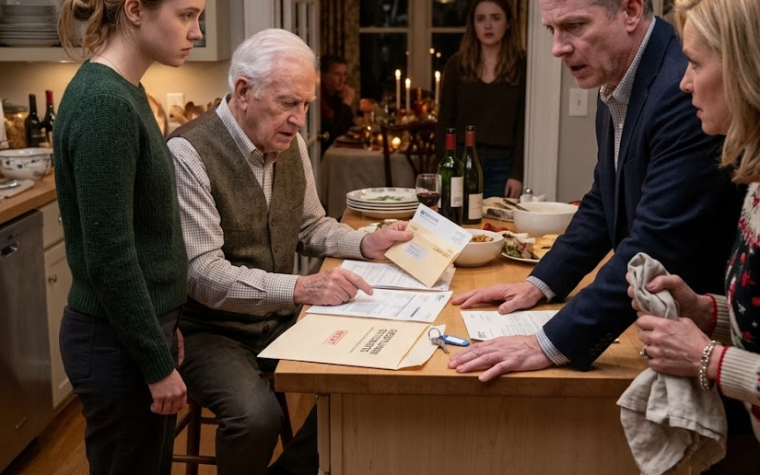
Franco’s hands remained flat on the table.
“You thought she belonged to you.”
“She would have, eventually.”
The video feed jolted.
A voice shouted from somewhere behind Roberto.
He turned, reached for the computer, and the screen went black.
At the airfield, state investigators entered the hangar before his plane could taxi.
Roberto attempted to leave through a service door and was taken into custody beside a stack of luggage containing cash, forged identification, and the missing basement hard drives.
He did not disappear.
He received a lawyer, a booking photograph, and a court date.
At his arraignment, Roberto walked into the courtroom wearing a tailored suit.
He looked toward the benches as though expecting his family to rise for him.
No one did.
Franco sat behind my mother and sister.
Nicholas sat near the aisle.
Lucia held a handkerchief in both hands.
Roberto’s gaze found me.
For one instant, the courtroom vanished, and I was back beneath the stairs listening to his shoes cross the kitchen above my head.
Then the clerk called my name as the complaining witness.
I did not look away.
The judge read the charges: kidnapping, aggravated unlawful restraint, conspiracy, evidence tampering, battery, and multiple offenses connected to the hospital security breach.
Roberto turned toward Franco.
“Fix this.”
Franco’s answer was quiet enough that only those closest to him heard it.
“I already did.
I gave them everything.”
Dean Mercer accepted a plea agreement and testified.
He admitted that Roberto had paid him to provide employee schedules, disable cameras, and obtain the sedative used in the garage.
He had told himself no one would be seriously hurt.
The basement recordings destroyed that excuse.
Roberto went to trial eight months later.
By then, my ankle had healed into a pale ring of scar tissue.
My voice had returned, though it became rough when I was tired.
I could sleep with the lights off, but only if the bedroom door remained open.
On the witness stand, Roberto’s attorney tried to make my refusal in the emergency room sound flirtatious.
He asked whether I had smiled at his client.
Whether I had been friendly.
Whether I could have misunderstood his attention.
I answered each question without anger.
Then the prosecutor asked what Roberto had said when I rejected him.
I looked directly at him.
“No one says no to a Ravellini.”
The jury heard the same sentence again on the recording from Franco’s estate.
They heard Roberto describe me as leverage.
They watched him say I was supposed to learn gratitude.
They deliberated for less than five hours.