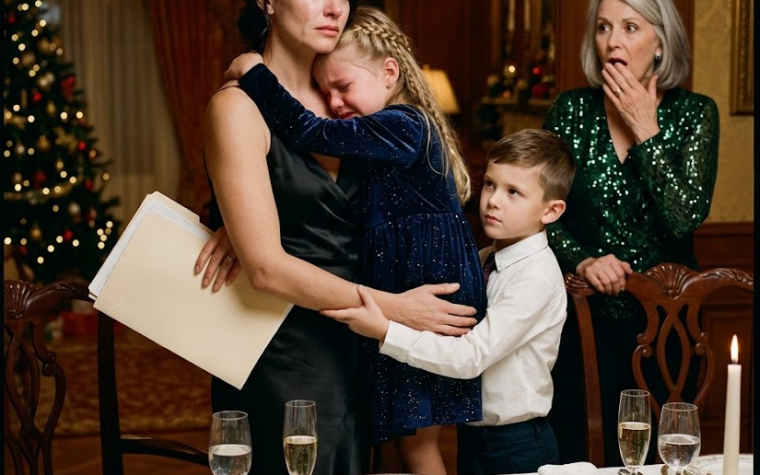
When asked why he had brought the incompetency petition to the hospital in his coat pocket, he stopped answering.
The charges against them reflected years of conduct, not only the final night.
Victor was convicted of offenses connected to the assaults, the poisoning scheme, the forged documents, and the attempt to gain control of the trust.
My mother was convicted for her participation in the poisoning, fraud, conspiracy, and abuse.
Their sentences were different, but both were long enough that I would not have to see them again unless I chose to.
I did not choose to.
On my twentieth birthday, the trust transferred to me under independent supervision.
There was no party.
No candles.
No dramatic celebration.
I sat in a small apartment with two locks on the door and a smoke detector that contained nothing except a fresh battery.
The administrator placed the final documents on the table.
For a moment, I could not pick up the pen.
Victor had spent years teaching me that documents were traps.
My mother had taught me that signatures could be stolen, copied, or used to erase a person’s rights.
The administrator waited without rushing me.
I read every page.
Then I signed my name.
Nothing terrible happened.
No one raised a hand.
No one told me I was confused.
No one stood behind me laughing.
I used part of the money for medical care and therapy.
I secured a home they had never entered.
The remaining funds stayed protected while I learned how to manage them myself—the very thing Victor had insisted I was incapable of doing.
Months later, the detective returned the original memory card in a sealed evidence envelope.
The case had been resolved, and the files had been preserved elsewhere.
I held the card between my fingers.
It was smaller than my thumbnail.
Victor had believed power looked like a raised flashlight, a locked drawer, or a document forced beneath someone’s hand.
Mine had looked like silence.
It had looked like an old camera hidden above the kitchen table.
It had looked like surviving long enough for a doctor to notice what everyone else had agreed not to see.
I placed the memory card inside a box with my father’s camera and closed the lid.
For the first time since I was thirteen, I did not need to hide either one.
That night, I made tea for myself.
I watched the water change color.
I carried the cup to the window.
My hands were steady.
Before drinking, I paused—not because I was afraid, but because the choice belonged to me.
Then I took a sip, turned off the kitchen light, and walked away without asking anyone’s permission.