He visited Mrs.
Bell downstairs.
He repaired the leaking window in their building after discovering the landlord had ignored it for months.
He arranged groceries anonymously until the girl caught him carrying bags up the stairs and informed him that anonymous people were not supposed to knock.
He learned she hated peas, liked library books about planets, and kept Hannah’s old nursing badge in a box beside her bed.
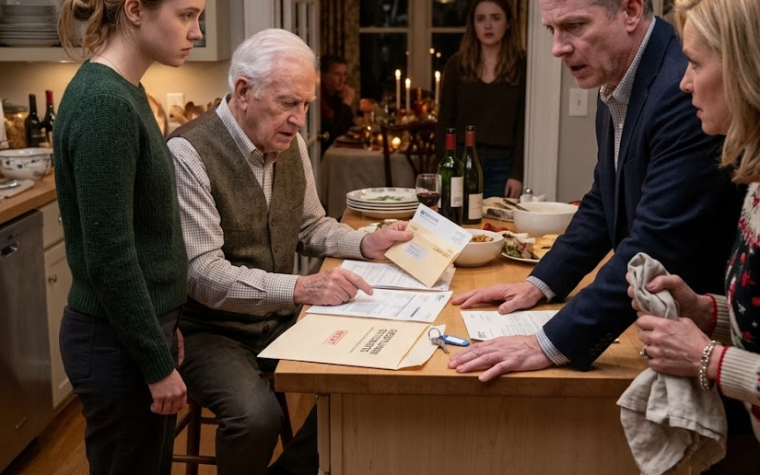
One evening she brought the box into the kitchen.
There was a photograph inside Lucas had never seen.
Hannah stood outside an emergency room, younger, exhausted, wearing the coat he had ruined twelve years earlier.
The stain had never completely come out.
On the back, in Hannah’s handwriting, were six words.
Some people survive before they change.
Lucas read the sentence twice.
The girl watched him.
“Was she talking about you?”
“I don’t know.”
“She said you were stubborn.”
Lucas looked up sharply.
“She talked about me?”
“A little.”
“What did she say?”
The girl shrugged.
“That once she helped a man who thought being scary meant he didn’t need anybody.”
Lucas looked back at the photograph.
“That sounds uncomfortably specific.”
The girl smiled.
It was the first time he had seen her do it without caution.
Months later, Lucas returned to Hancock Meridian with her.
The chandelier was the same.
The marble was the same.
The leather couches were the same.
But nobody laughed when she approached the counter.
A new director greeted her at eye level.
She placed the black card on the marble.
“Do I still need this?” she asked.
Lucas looked at the object that had frozen his empire, exposed his closest lieutenant, cost him partners, opened years of buried theft, and forced him to choose what kind of man he would be when power demanded a lie.
The attorney beside him said the card had completed its function.
It could be destroyed if she wanted.
The girl picked it up again.
“No.”
Lucas raised an eyebrow.
“Why keep it?”
She slipped it carefully into the repaired pocket of her yellow dress.
“Because Mommy was right.”
“About what?”
She looked around the lobby where, months earlier, adults had treated her grief like a joke.
“People tell you things are worthless when they’re hoping you won’t check.”
Lucas had built his life by making other people afraid to ask questions.
Hannah had left behind a child who asked one anyway.
He thought about the empire he had lost pieces of, the men who had abandoned him, and the power he once believed had to be protected at any cost.
Then he held the bank door open for the girl.
She walked into the Chicago afternoon ahead of him, muddy sneakers replaced but the blue thread still visible on her pocket because she had refused to let anyone resew it.
Lucas followed.
For the first time in years, losing power did not feel like losing everything.