The word entered me like ice.
I opened the security clip again and pressed play from the beginning.
Mark’s mother came out of the shadow.
She opened the paper bag.
Mark distracted Ava.
The muffin disappeared into the lunchbox.
Then came the words I would later hear dozens of times in interviews, depositions and court.
“Once Sarah sees nothing happens, she’ll stop keeping Ava from me.”
Mark answered, “Just make sure she eats it here.
Sarah can’t know.”
I turned the volume up until his own voice filled the bathroom.
Outside the door, he went silent.
Then he said, “She told me it was peanut-free.”
It was his first version of the lie.
By the time the police arrived, he had created three more.
First, he claimed his mother had brought an ordinary blueberry muffin because Ava disliked daycare food.
Then he said he had never seen the muffin at all.
Finally, when an officer told him the footage had audio, he insisted they had been discussing a different meal.
The officers separated us.
One remained with me in the living room while another spoke to Mark in the kitchen.
Ava’s toys were still scattered beside the couch.
Her stuffed rabbit sat upright against a cushion where she had left it.
Mark’s low voice carried from the other room as he explained that grief had made me confused and unstable.
I looked at the officer beside me.
“He knew exactly what was in that lunchbox.”
The officer asked whether Ava had a documented allergy.
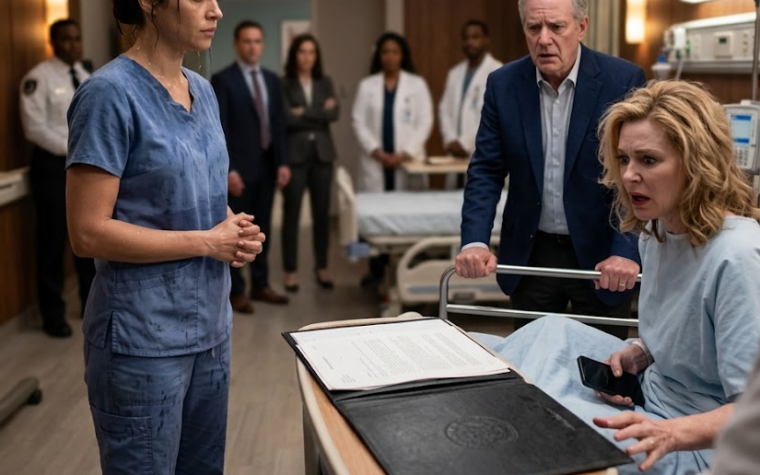
I brought him the red emergency folder we kept in the kitchen cabinet.
It contained her diagnosis, her daycare action plan, prescription records and the form Mark had signed acknowledging that even trace exposure could be life-threatening.
His signature appeared beneath mine.
I did not cry when I handed it over.
I had cried so much that week I thought there was nothing left inside me.
But as the officer turned those pages, grief hardened into something steadier.
Evidence.
Mark had spent five days controlling every detail because he believed sorrow had made me helpless.
He arranged the funeral.
He answered relatives’ questions.
He collected Ava’s belongings from the hospital before I could see them.
He even told me there was no reason to speak to the daycare because “accidents happen, and blaming people won’t bring her back.”
Now I understood why.
Shortly before dawn, the officers took Mark to the station for questioning.
He was not arrested that night, but they seized his phone and told him not to contact his mother.
He looked at me as they escorted him outside.
“You’re destroying what’s left of our family,” he said.
I stood in the doorway wearing Ava’s old blanket around my shoulders.
“You destroyed it at 8:17 Tuesday morning.”
Miss Greenwood came to my house after sunrise.
She carried a flash drive and a sealed envelope.
The drive contained footage from three cameras: the entrance, the hallway and the classroom doorway.
The envelope held a written timeline she had prepared after reviewing the recordings.
She told me why she had gone back to look.
On the afternoon Ava died, Mark returned to the daycare alone.
He said he needed to collect Ava’s coat and water bottle.
While he was there, he casually asked whether the entrance cameras recorded sound and how long the system kept old files.
“He tried to sound calm,” Miss Greenwood said, “but he kept staring at the camera above the office door.”
The next day, the daycare director received an email from Mark requesting that all footage of Ava be deleted because watching it would be “too painful for the family.” He claimed I had agreed.
I had known nothing about the request.