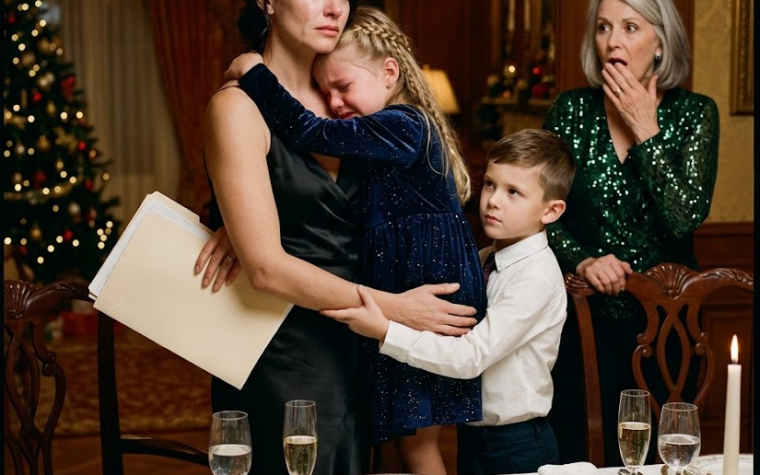
“Then judge what I do next.”
That was the first useful thing he said.
Within forty-eight hours, the Hayes Global board placed Walter on temporary leave pending an independent review.
The trust administrator suspended his authority over beneficiary matters.
Weeks later, the trust protector formally removed him as trustee for deliberate concealment and failure to disclose qualified descendants.
Walter did not lose everything.
Real consequences are rarely that theatrical.
He retained personal wealth, property, and shares.
What he lost was the power he valued most: the ability to decide whose existence mattered.
The four boys were recognized as beneficiaries under the trust, with their interests protected until adulthood by an independent fiduciary Walter could not control.
No fortune was handed to five-year-olds.
No palace doors opened overnight.
Their school lunches still needed packing.
Shoes still vanished beneath furniture.
One still refused to eat anything green, while another insisted every bedtime story required a dragon.
Their lives remained real.
That was precisely what I wanted.
My company completed its public offering months later.
Reporters tried to frame its success as revenge financed by a discarded wife’s settlement.
I corrected them once.
Walter supplied capital.
I supplied the five years of work.
After that, I stopped explaining.
Colton began visiting the boys in a quiet park near our home.
The first meetings were awkward.
He brought expensive gifts, and I made him take most of them back.
“They need your attention,” I told him.
“Not proof that you can purchase it.”
So he learned.
He pushed swings.
He carried snacks.
He listened to four stories at once and admitted when he could not tell which boy had hidden his keys.
During their sixth visit, one son asked the question Colton had been dreading.
“Why didn’t you come before?”
Colton looked toward me, but I did not rescue him.
He lowered himself onto the grass.
“I didn’t know where you were,” he said.
“But I should have asked harder questions.
I let someone else decide what I believed.”
The boy considered this.
“Grandpa?”
“Yes.”
“Is he mean?”
Colton glanced down at his hands.
“He did something cruel.
And I was too afraid of him for too long.”
Children understand honesty more easily than polished excuses.
My son nodded, then handed Colton a toy car with one missing wheel.
The conversation moved on.
Mine did not.
I had imagined that exposing Walter would feel like triumph.
Instead, the strongest emotion was grief for the ordinary years no document could restore.
There would be no first steps for Colton to witness, no infant cries for him to learn, no chance to become the father he might have been from the beginning.
But there could be something after grief.
Not a restored marriage.
Not yet, and perhaps never.