Minutes later, in a small room behind the chapel, I closed the door and removed the brooch from my dress.
My hands were shaking so badly that I almost dropped it.
That was the part Evelyn never understood about restraint.
Calm did not mean I felt nothing.
Calm meant I had learned how to keep moving while every part of me was screaming.
The contact from the district attorney’s office entered after me and locked the door.
I handed over the brooch.
“It’s all there,” I said.
They did not ask me to explain.
We had already spoken before the funeral.
The recording was copied immediately.
Evelyn’s voice came first, low and unmistakable.
“God took them because He knew what kind of mother you were.”
Then mine.
Then the sound of the slap.
The impact against the coffin.
Her next words were even clearer.
“Stay quiet, or you’ll join them.”
Ryan’s voice followed seconds later.
“Enough, Hannah.
Don’t embarrass yourself.”
I closed my eyes.
Hearing it again was worse than living it because the recording stripped away every excuse.
There was no confusion, no grief-distorted memory, no question about tone.
It was simply what had happened.
My contact looked at the injury on my temple.
“Photographs first,” they said.
I nodded.
We documented the swelling, the redness across my cheek, and the small cut near my hairline.
Then I gave a short statement about what had happened in the chapel.
But the funeral assault was only the newest piece.
I opened my handbag and removed a plain folder.
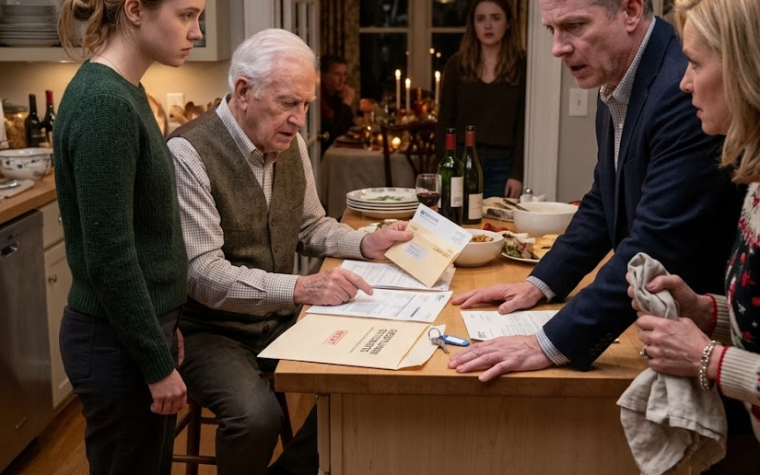
Ryan thought he had taken the important documents from our house.
He had taken paper.
He had not taken my memory, my photographs, or the copies stored outside the house.
Inside the folder were images of insurance forms, account records, medical authorizations, and pages Ryan had asked me to sign during the twins’ illness.
At the time, exhaustion had reduced my world to feedings, temperatures, medication times, hospital chairs, and the terror of watching two tiny bodies struggle at once.
Ryan would place a form in front of me and say, “They need this now.”
I trusted my husband.
So I signed where he pointed.
Later, after Ethan and Ava died, I found documents in our home that did not match what I remembered signing.
Some pages had been substituted.
Some contained information I had never provided.
One insurance document listed changes I had never requested.
Another legal form made it appear that I had agreed to give Ryan broad authority over financial matters if my mental condition made me incapable of handling them myself.
The most disturbing pages were not dramatic at first glance.
They were notes.
Dates.
Statements describing me as confused, irrational, unstable, unable to understand medical advice.
Some were Ryan’s.
Some repeated language Evelyn had used in front of doctors.
The pattern was obvious to anyone who had ever built a fraud case.
First establish that the target cannot be trusted.
Then control the records.
Then control the money.
My contact compared two signatures.