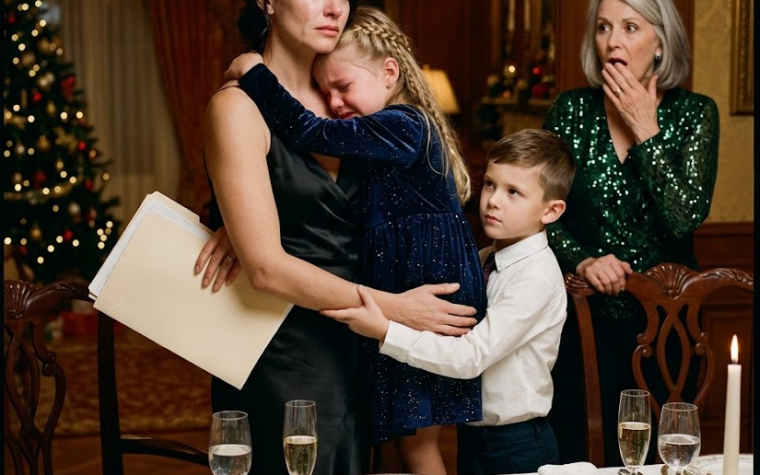
Adam closed his eyes.
I glanced at him.
“So that was the plan? Sell my grandfather’s house because you were afraid my illness might cost you something?”
“That’s not what I said.”
“It’s exactly what you said.”
Joyce quietly moved the original folder farther from Judy’s reach.
That tiny motion seemed to break the last bit of Judy’s composure.
She reached for her purse.
“This meeting is over.”
“No,” I said.
“For you, maybe.
Not for the paperwork.”
She turned toward me.
“What is that supposed to mean?”
“It means I’m reporting the document.”
Adam stepped forward.
“Jacqueline, please.”
I looked at the man who had stood behind his mother while she told me I was too sick to enjoy the place where my grandfather taught me how to feel safe.
“You asked me not to make this harder than it needed to be.”
His face crumpled slightly.
“So I won’t.”
For one hopeful second, he misunderstood me.
Then I continued.
“I’m going to make it exactly as serious as it is.”
I made the call.
There was no dramatic entrance, no instant pair of handcuffs, no theatrical ending.
Real consequences moved more slowly than Judy’s schemes.
But they moved.
The disputed transaction was formally terminated.
The buyers received their money back and documentation explaining that the seller had never authorized the transfer.
Joyce preserved every version of the paperwork Judy had submitted, along with the dates and communications surrounding the attempted sale.
I provided copies of my hospital records and a signed statement denying that I had ever granted Judy power of attorney.
The questioned documents were referred for review.
Judy spent the next several weeks doing what she had done in the office: denying, minimizing, and changing explanations.
First she said I had verbally authorized her.
Then she said Adam had authorized her on my behalf.
Then she said she believed marriage gave him the right to do so.
Then she insisted the signature must have been a misunderstanding caused by paperwork someone else prepared.
Every new explanation contradicted the one before it.
The investigation did not need Judy to confess dramatically.
It had documents, dates, my denial, the property records, the transaction history, and the people she had spoken to while representing herself as my legal agent.
The attempted sale became a fraud matter instead of the private family disagreement Judy had counted on keeping it.
My lake house remained mine.
That should have been the end of the story.
It wasn’t.
Adam came home one evening after I was released from the hospital and found a suitcase beside the front door.
He stared at it for several seconds.
“Is that mine?”
“Yes.”
He looked exhausted.
“My mother made a terrible mistake.”
I was sitting at the kitchen table with my medication schedule beside me and my grandfather’s old lake-house key resting near my hand.
“You keep calling choices mistakes.”
“I didn’t forge anything.”
“I know.”
He seemed relieved until I continued.