To remove the weapon from Sharon’s hand.
When the result arrived, my husband called her.
He told her the accusation was over.
He emailed her the report.
Then he warned her never to mention the subject around either child.
Sharon’s reply consisted of four words.
“Tests can be wrong.”
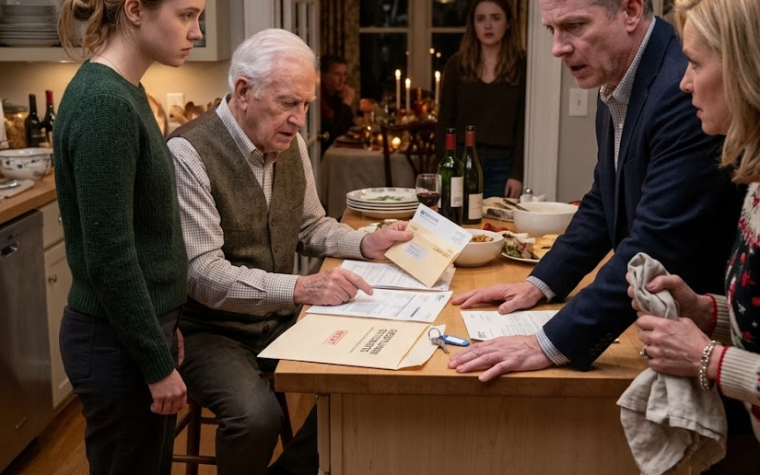
My husband showed that message to Lawrence now.
Lawrence took the phone and read it twice.
“You knew?” he asked Sharon.
She straightened her shoulders.
“I knew what the report claimed.”
“No,” Lawrence said.
“Did you know the test confirmed she was his daughter before you said that to her?”
Sharon’s mouth tightened.
The Christmas music continued playing in the background, absurdly cheerful.
A singer promised peace on earth while my six-year-old daughter clung to me and tried to understand why the woman she called Grandma had rejected her.
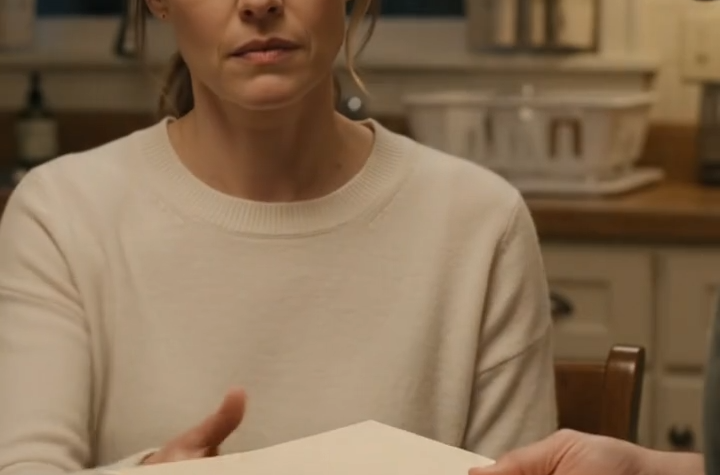
Melanie finally put down her coffee.
“Mom,” she said, “answer him.”
Sharon looked around the room and realized, perhaps for the first time that afternoon, that nobody was rushing to protect her.
“I had doubts,” she said.
“You had proof,” my husband replied.
“I had a piece of paper.”
“You had the truth.”
Sharon’s eyes flashed.
Then she pointed at me.
“This family started falling apart when she arrived.”
There it was.
The real accusation.
It had never been about Mia’s hair, a laboratory report, or some imaginary secret.
Sharon had decided years earlier that I was responsible for every change she disliked in her son.
Before we married, my husband spent most weekends at his parents’ house.
Sharon chose where the family ate, how holidays were celebrated, and which disagreements were permitted to exist.
After we married, he began building a life with me.
He stopped answering every call during dinner.
We alternated holidays.
We made decisions about our home and our children without asking Sharon’s permission.
To her, those ordinary boundaries felt like betrayal.
Mia had simply become the easiest target.
“She didn’t break this family,” my husband said.
“You did that when you decided hurting a child was easier than admitting you were wrong.”
Sharon’s expression hardened.
“I have sacrificed everything for you.”
“And Mia spent a week making you a Christmas picture.”
He picked up the drawing from the couch.
The paper had been folded slightly where Sharon pushed it back.
In the center, Mia had drawn Sharon in a bright red dress, smiling beneath the tree.
The purple letters above the figures were uneven but readable.
I love Grandma and Grandpa.
My husband held the drawing toward his mother.
“She loved you without needing proof,” he said.
“You had proof and still chose not to love her.”
Sharon looked away.
Noah stepped closer to Mia.
“You can have my car,” he told her.
Mia shook her head.