The criminal case moved faster than the estate.
Victoria’s attorney first described the fall as an accident.
After receiving the stairwell footage, he called it a reflexive movement during an argument.
When investigators obtained Patterson’s statement and the torn estate pages from Victoria’s purse, the explanation changed again.
She claimed I had threatened to ruin her wedding and lunged at her.
The video showed me turning away.
She claimed the recording had no sound and could not prove her intent.
Patterson’s testimony supplied the words she had shouted.
The position of her hands supplied the rest.
She claimed she had immediately sought help.
The emergency log showed that the building’s monitoring service called first.
Victoria’s own phone records showed that she spent fifty-two seconds calling her wedding planner before dialing anyone connected to my fall.
That detail hurt in a way the fracture did not.
While I lay unconscious on the landing, my sister had tried to protect a reservation.
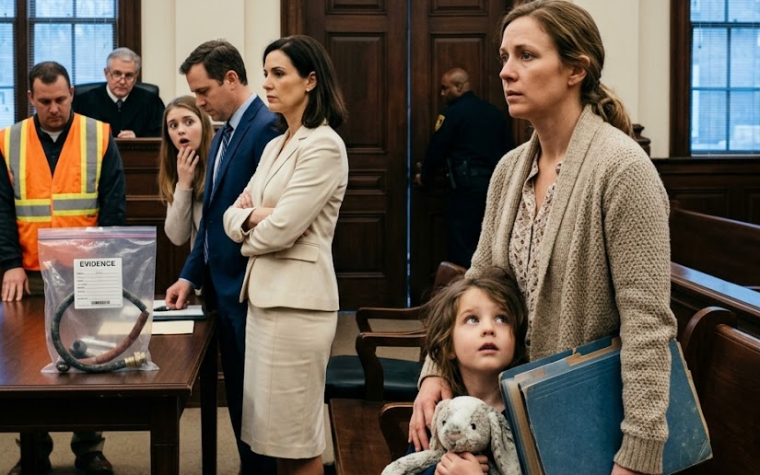
At the preliminary hearing, I entered the courtroom wearing the brace beneath a loose black jacket.
Victoria sat beside her attorney in a cream suit she might once have chosen for a bridal event.
She did not look at me until the prosecutor played the footage.
The screen showed the same sequence: the blocked hallway, the forced stairwell entry, the torn paper and the shove.
Victoria watched herself stand above the stairs while I disappeared from view.
When Patterson testified, her attorney suggested grief had distorted his memory.
Patterson opened his calendar and read the note he had typed immediately after the incident.
“Victoria Brennan shouted, ‘Dad’s money is for my wedding.’ Seconds later, I heard repeated impacts from the stairwell.”
The defense stopped questioning him soon afterward.
Outside the courtroom, Victoria tried to approach me despite the temporary no-contact order.
Her attorney caught her arm before the deputy had to intervene.
She called my name.
I kept walking.
The wedding did not happen at the Belmont estate.
The remaining deposits came due while Victoria was barred from contacting me or accessing the disputed inheritance.
Her fiancé attended one hearing, watched the video and left before she did.
Patterson later told me the engagement ended the following week.
I felt no victory when I heard that.
A canceled wedding did not repair a spine.
Public humiliation did not recreate the sister I had once hoped she might become.
Months later, Victoria accepted a plea rather than face a trial with two camera angles, a witness and physical evidence.
The judge imposed a custodial sentence followed by supervision, mandatory counseling and restitution.
During sentencing, Victoria apologized for what she called “a moment that got out of control.”
The judge asked her when that moment had begun.
Was it when she waited outside the office?
When she blocked the elevator?
When she forced me into the stairwell?
When she tore the estate document?
When she raised both hands?
Victoria did not answer.
The judge said a moment could not explain a chain of deliberate choices.
The civil case ended in a court-approved settlement.
Victoria’s inheritance was not magically erased, and Dad’s will was not rewritten.
Instead, the court allowed a portion of her distribution to satisfy the documented costs and damages caused by the assault, including rehabilitation expenses, lost work and the care I required at home.
The remainder stayed hers under the terms Dad had signed.
Some people told me I should have pursued every dollar.
I did not.
I wanted accountability, not another inheritance war.
Nearly a year after the fall, I returned to Patterson’s office to sign the final estate documents.
The framed degrees were still on the wall.
The brass lamp cast the same soft circle across the desk.
My reflection appeared in the polished wood, but I barely recognized the woman from our first meeting.