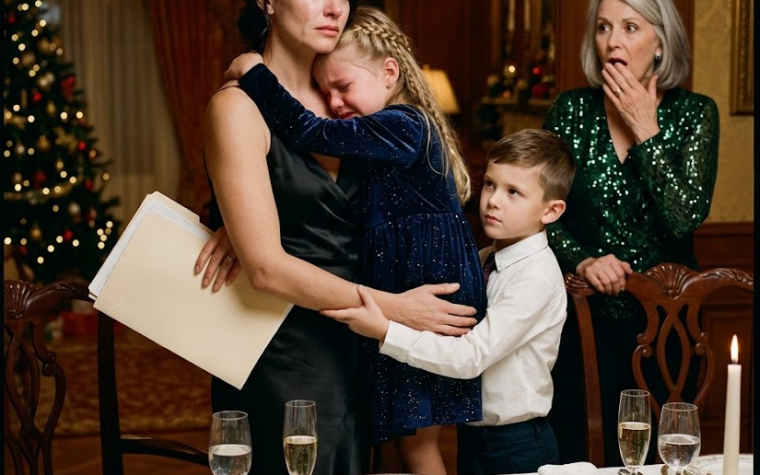
She told him about second grade, the tooth she had lost, the bicycle she could almost ride without help and the lamp beside her bed that stayed on every night.
He listened as though each ordinary detail were a classified message he had crossed a desert to receive.
Halfway through the song, he looked at me and held out his other hand.
I joined them.
His palm felt rougher than I remembered.
His face looked older.
The man who returned was not untouched, and neither were Emma and I.
Our family had not been restored to the exact shape it once had.
But when his fingers closed around mine, the empty place beside us was empty no longer.
The following morning, the school board held an emergency meeting.
The recording from the dance was played in full.
Parents submitted written statements describing what Melissa had said and how long she had allowed Emma to stand alone while others laughed.
Melissa claimed her words had been taken out of context.
Then she said grief made children disruptive.
Then she argued that my husband’s dramatic return had influenced everyone against her.
Each defense exposed the same belief: she still thought Emma had been the problem.
The board removed her as PTA president and suspended her volunteer access while the district completed its review.
She was required to provide a written apology, but the principal made one condition clear to me.
Emma did not have to read it.
She chose not to.
The parents who had laughed were not removed from their own guilt so easily.
Several came to our home with flowers and rehearsed apologies.
My husband thanked them for coming but did not comfort them.
One father admitted that he had watched Melissa target other families before.
A grandmother raising two boys had been mocked for attending a parent breakfast.
A girl whose father was incarcerated had been told not to appear in an event photograph.
Everyone had considered those moments unpleasant.
No one had considered them urgent.
Until a dead man walked through the door.
The school replaced the Father-Daughter Dance with a Family Dance open to any trusted adult.
Staff members were assigned to intervene when children were isolated or humiliated.
The changes could not undo what happened to Emma, but they stopped the same cruelty from being dressed up as tradition again.
My husband’s return brought other consequences that were quieter and harder.
He woke at sudden sounds.
He sat facing doors.
Some nights he slept on the floor because the bed felt too soft.
Emma wanted him beside her every minute, terrified that closing her eyes might make him disappear again.
We learned not to promise that everything was normal.
Instead, we promised what we could keep.
He would tell us when he needed space.
I would tell him when his silence frightened me.
Emma could check the scar above his eyebrow whenever she needed proof.
A month after the dance, we visited the cemetery.
His name was still carved into the stone.
The grave beneath it held the remains of another soldier whose family had finally been located through the corrected DNA records.
My husband stood before the marker for a long time.
“I lived under another man’s death,” he said.
I took his hand.
“And we mourned beside the wrong name.”
Emma placed the lavender ribbon from her dance dress against the stone.
Then she squeezed her father’s fingers three times.
He squeezed back.
On the walk home, she asked him whether he would attend the next school dance.
He looked down at her with tears shining in his eyes.
“I missed two years of your life,” he said.
“From now on, when you look toward a door, I want you to know I’m trying to be on the other side.”