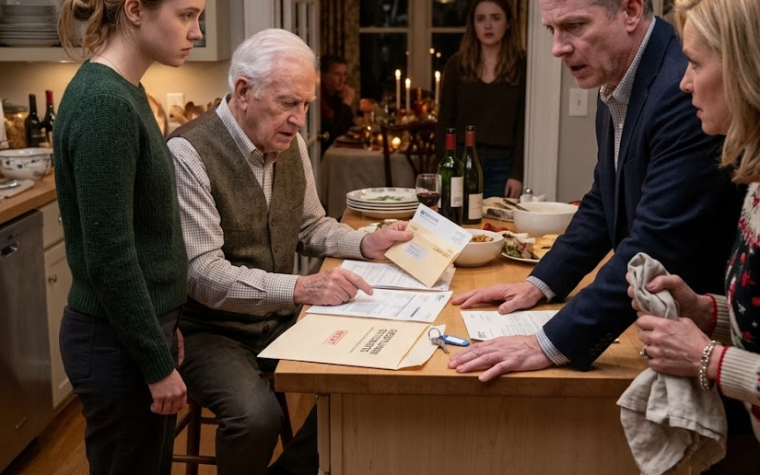
Then he admitted what had been behind the demand.
Amber wanted to renovate the kitchen and open the wall between the kitchen and family room.
They had already received estimates.
The project cost far more than they had available without taking on additional debt.
At some point, Amber had convinced herself that because the trusts existed for the children, improving the family home could be described as improving the children’s lives.
Derek knew that interpretation was weak.
He had gone along with asking anyway.
“She said it was ridiculous for five hundred thousand dollars to sit there while we’re struggling,” he said.
“It isn’t sitting there.
It’s invested for Lucas and Sophie.”
“I know.”
“Do you?”
He looked at me.
I opened the folder the attorney had sent over after our review.
I did not hand Derek private account details.
I showed him the portions relevant to trustee authority and permitted distributions.
“Your father and I did not create this because we distrusted you,” I said.
“We created it because life changes people.
Pressure changes people.
Marriages get strained.
Jobs disappear.
Good parents make frightened decisions.
These documents are supposed to be stronger than one bad season.”
Derek read quietly.
Then he reached the paragraph explaining that no parent or guardian possessed an automatic right to direct distributions.
His face changed.
“Amber thought because we’re their legal guardians—”
“The trusts are separate legal arrangements.”
“So there was never a way for us to just take control?”
“No.”
He leaned back.
For the first time, I understood that Amber had not merely wanted me to agree.
She had apparently assumed my agreement would be enough to make the money theirs to manage.
That assumption had been wrong from the beginning.
Derek left with a copy of the relevant provisions the attorney had approved for sharing.
The next evening, Amber called me herself.
She skipped hello.
“You showed Derek the paperwork.”
“Yes.”
“You made me look like I was trying to steal from my children.”
“I never used that word.”
“You didn’t have to.”
Her voice had lost the polished sweetness she used at parties.
“Amber, you asked me to transfer control of money that does not belong to you.
I said no.
The documents say no.
That is the entire situation.”
“We are their parents.”
“And I am their trustee.
Those are different roles.”
“You enjoy this.”
That accusation surprised me because of how completely false it felt.
There was no pleasure in hearing my son’s marriage strain around money.
There was no satisfaction in realizing the woman raising my grandchildren viewed their future funds as a solution to her present frustration.
“No,” I said.
“I enjoyed your son’s birthday.