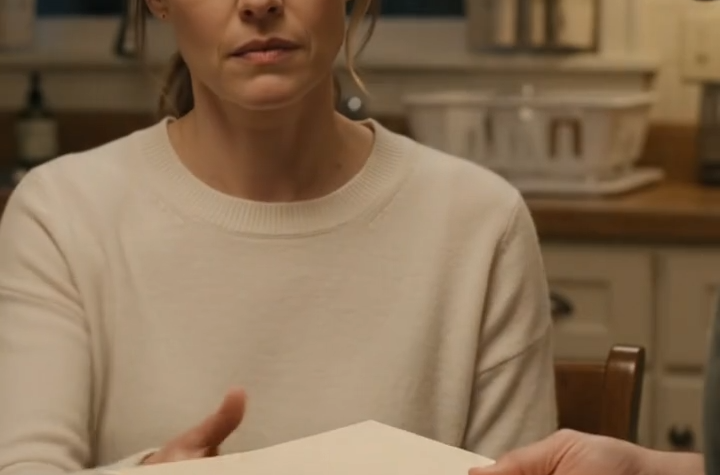
Megan read every page before signing.
She crossed out a clause that allowed the company to approve exterior changes.
Henry accepted the revision.
“You’re not going to argue?” she asked.
“It’s your bakery.”
“It was my bakery last month too.”
“I know.”
Her expression told him that knowing late was not the same as knowing when it mattered.
He kept returning anyway.
At first, he came to provide updates.
Then he came for the sourdough.
Then he stopped pretending there was a business reason.
Megan charged him the full price.
One morning, he placed four dollars on the counter.
She looked at the money.
“The roll is two.
Coffee is three fifty.”
“Your math was different last time.”
“Last time you looked hungry.”
“And today?”
“Today you look guilty.”
“That seems more expensive.”
“It is in my bakery.”
He laughed—an unguarded sound that surprised both of them.
Their relationship did not change with one grand gesture.
It changed in small, stubborn increments.
Henry learned that Megan arrived before dawn because she liked the quiet hour when the ovens were warming and nobody needed anything from her.
Megan learned that Henry hated being driven because the back seat made every journey feel like a meeting.
He helped carry flour one morning and tore the shoulder of an expensive coat.
She laughed until she had to lean against the counter.
“You could buy the flour company,” she said.
“That would not make this bag lighter.”
“No, but you’d probably form a committee to study it.”
He began leaving both phones in the Civic when they walked through Coal Valley after closing.
She began believing that his attention was not another acquisition strategy.
Still, she refused to let him hide behind charm.
One evening, Henry admitted why he had dressed down that Sunday.
“I was tired of not knowing whether anyone liked me or what I could do for them.”
Megan locked the bakery door and turned the sign toward the glass.
“You thought looking poor would show you the truth.”
“I thought disappearing might.”
“You didn’t disappear.”
“What did I do?”
“You went looking for proof that you were still human.”
Henry looked at her.
“And did I find it?”
She considered him for a long moment.
“You found someone willing to tell you when you weren’t acting like one.”
“That wasn’t the answer I hoped for.”
“It’s the answer you needed.”
Then she took his hand.
Months later, the redesigned Coal Valley plan was approved.
The bakery remained where it had always been, its faded gold sign restored but not replaced.
No luxury tower rose over it.
The new construction curved around the existing storefronts, preserving the businesses that had given the neighborhood its character.
Henry stepped away from several daily responsibilities at his company and created a tenant review panel with authority independent of the executives whose bonuses depended on acquisition speed.