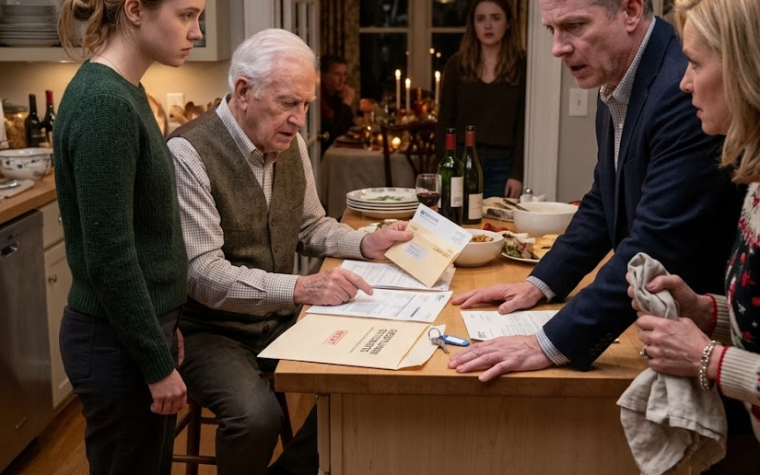
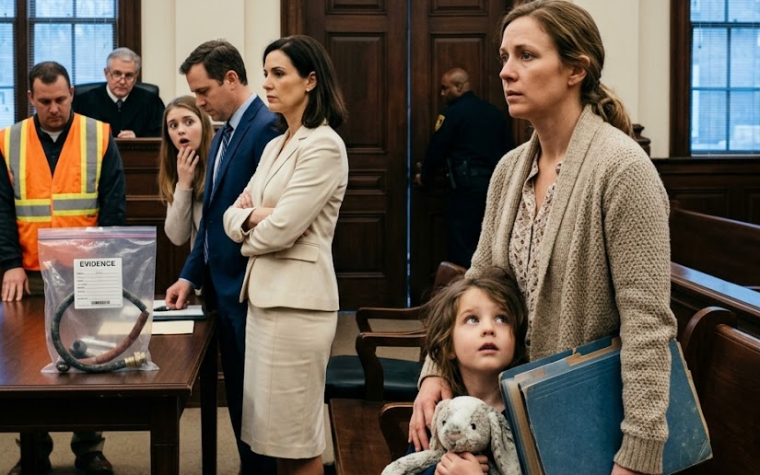
He flinched.
“I was trying to keep everybody happy.”
“No.
You were trying to avoid making anybody angry with you.”
He looked toward the door.
I continued before he could escape into silence again.
“You did not have to shout at Brittany.
You did not have to humiliate her.
You only had to say one sentence when I walked in.”
He knew which sentence.
This is my mother’s house.
He had not said it.
That failure had allowed every other lie to breathe.
“I’m sorry,” he whispered.
I believed he was sorry.
I did not confuse that with repair.
The legal and financial arguments that followed were handled through attorneys and written records.
Ron and Sheila had to confront the fact that the promises they relied on had not come from the owner.
Brittany had to explain why she changed locks and represented the property to police as though I had no right to be there.
Evan had to explain every statement he had made to his wife and her parents about a house he knew was mine.
No dramatic speech solved those problems.
Paperwork did.
Dates did.
Signatures did.
The absence of my signature did most of all.
Weeks later, when I returned to the mountain house alone, the new lock turned cleanly beneath my hand.
Inside, the mantel was restored.
My photographs were back where they belonged.
The kitchen was quiet.
I made coffee in my own machine and poured it into the mug Sheila had used that afternoon.
For a moment I thought about throwing it away.
Then I laughed softly at myself.
It was a mug.
The house was still mine.
That distinction mattered.
Evan and I did not return immediately to the relationship we had before.
I would not pretend his silence had been harmless simply because the deed protected me from its worst consequence.
Trust, unlike property, does not come with a registry where ownership can be proven by pulling one certified page from an envelope.
He began calling more often.
I answered when I wanted to.
He apologized without asking me to make his guilt disappear.
That was a beginning.
Not forgiveness.
A beginning.
As for Brittany, the last image I carried from that day was not her shouting into the phone.
It was the instant upstairs when the safe clicked open and she realized the house had been holding a record stronger than her confidence.
She had believed volume was authority.
She had believed my age made me easy to displace.
She had believed Evan’s silence could stand in for my consent.
She was wrong about all three.
Richard used to tell me that a house remembers who cares for it.
I never knew whether I believed that literally.
But standing beside his portrait in the quiet he had built for me, I understood something close to it.
They had moved my coat.
They had moved my photographs.
They had changed my locks.