I closed my eyes for one second and saw Frank at the lake, leaning against the porch rail with a mug in his hand.
Cancer had not taken his voice yet.
He was laughing because I had burned breakfast and insisted the smoke alarm was defective.
The house had never been valuable because of the market.
It was valuable because his fingerprints were still on the railing.
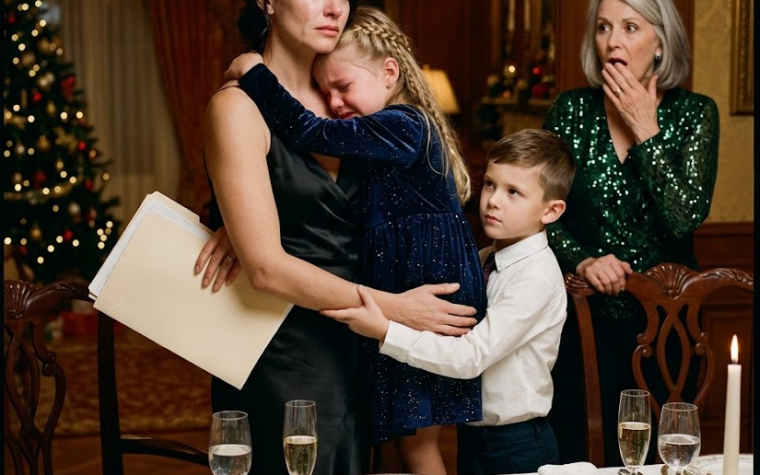
Anna came forward when court adjourned.
She wrapped both arms around me and held on.
“I thought she was going to take it,”
she whispered.
“So did she.”
Anna pulled back and looked at my retired military credential on the table.
“Why did you never tell them what you really did?”
“Your father knew.”
“That is not what I asked.”
I smiled despite myself.
“I spent my career proving things to judges.
I did not want to spend my marriage proving myself to Evelyn.”
Anna nodded slowly.
Across the room, Evelyn stood with the bailiff while her lawyers packed their files.
She called my name once.
I turned.
Her voice had lost its polish.
“You are keeping me from the last thing I have of my son.”
I looked at her for a long moment.
“No, Evelyn.
You tried to take the last home he gave his wife and daughter.”
She flinched.
I did not add anything else.
The sanctions hearing occurred several weeks later.
Evelyn was ordered to reimburse my court costs and pay a substantial penalty for filing claims without factual support.
Her attorneys avoided sanctions after producing their notes and showing that she had supplied the false timeline, though Judge Bennett criticized their failure to examine the recording stamp before filing.
The courthouse assault was handled separately.
Evelyn accepted responsibility for misdemeanor battery rather than force Anna and me through another contested hearing.
She received probation, mandatory counseling, and a no-contact order that prohibited her from approaching me without permission.
There was no dramatic prison sentence.
No cheering crowd.
Real consequences are often quieter than revenge fantasies.
She lost the lawsuit.
She lost money.
She lost the ability to frighten me through proximity.
Most painfully, she lost Anna’s trust.
That consequence could not be reduced to a dollar amount or repaired by an attorney.
In early summer, Anna and I drove to Smith Mountain Lake.
The house had been closed since Frank’s funeral.
Dust lay across the kitchen counters.
His old jacket still hung beside the back door.
A chipped blue mug remained upside down near the sink because neither of us had been able to put it away.
Anna opened the curtains.
Sunlight crossed the floor and reached the dining table where Frank had signed mortgage papers, birthday cards, and the letter approving Anna’s first apartment application.
I placed the courthouse folder in a cabinet.
Not on display.
Not like a trophy.
Just stored where I could find it if anyone ever confused my silence with helplessness again.
Anna carried two chairs onto the porch.
We sat facing the water as evening settled over the lake.
“Dad knew you would win,” she said.