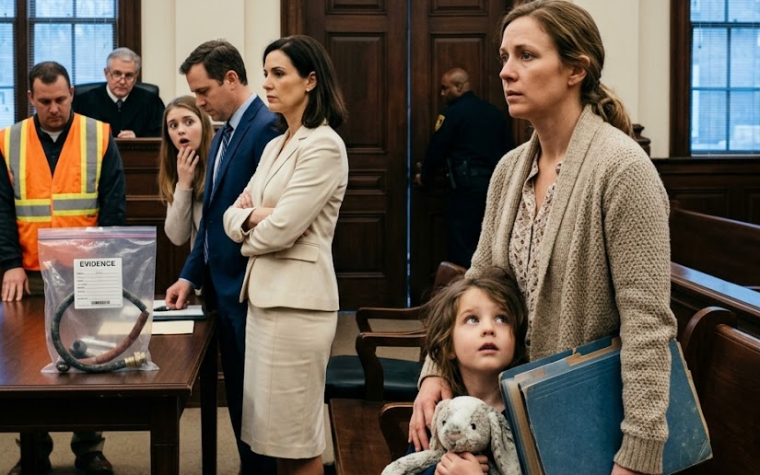
Walker, this court is not interested in Mrs.
Kensington’s opinion of you.
It is interested in whether you concealed assets while submitting sworn disclosures.”
Ethan’s attorney touched his arm, trying to stop him.
He pulled away.
“I didn’t conceal anything.”
Victoria remained perfectly still.
“Then you should welcome the audit.”
Ethan looked at her as if he hated her for saying it so calmly.
“You don’t know anything about my marriage.”
“No,” Victoria replied.
“But I know financial structures.
And I know what people do when they think complexity will protect dishonesty.”
The judge ordered preservation of records connected to the disputed entities and prohibited further movement of specified assets until the review could be completed.
Ethan finally stopped talking.
For the first time since our divorce began, he looked afraid of silence.
The weeks that followed were exhausting.
I did not move into a mansion or suddenly begin living like an heiress.
Victoria offered me anything I needed, but I accepted only a quiet place to stay where I could prepare for my son’s birth without wondering how I would pay the next month’s rent.
Mostly, we talked.
She showed me photographs of herself when she was young.
I saw my own expressions in her face.
She told me about the years after I disappeared, the investigators, the false leads, and the guilt that had shaped nearly every decision she made afterward.
I told her about foster homes, school, my first job, and the strange mixture of gratitude and resentment I felt toward a life I had survived without her.
Neither of us pretended the DNA test created twenty-eight years of memories overnight.
We started with coffee.
Then lunches.
Then one evening she helped me fold tiny baby clothes, and halfway through a pair of socks we both started crying.
The financial investigation moved faster than Ethan expected.
The forensic accountants reconstructed transfers from statements, ownership records, contracts, and corporate filings.
Each explanation Ethan offered seemed to create another question.
One company had supposedly purchased an asset from another at a suspiciously low valuation.
Another entity had received funds shortly before a required disclosure date.
Records showed Ethan retained influence over property he had portrayed as no longer his.
The picture became difficult to dismiss as ordinary restructuring.
When we returned to court, Ethan looked different.
His suit was still expensive, but his confidence no longer fit it.
My attorney presented the reconstructed financial timeline.
One transaction at a time.
One contradiction at a time.
Ethan’s attorney argued that corporate ownership was complicated and that mistakes in disclosure were not automatically intentional.
That argument lasted until an email was introduced from Ethan to one of his financial advisers.
The message did not say, in simple words, hide this from Madison.
It didn’t need to.
Its timing, instructions, and references to keeping particular holdings outside the divorce calculations were enough to destroy the innocent explanation he had been building.
Ethan blamed his adviser.
Then his accountant.
Then his attorney’s interpretation.
Finally, he blamed me.
“She never contributed to those companies,” he said.
“She doesn’t deserve half of everything I’ve built.”
My attorney looked at him.
“Whether you believed she deserved it was not a decision you were entitled to make by concealing it.”
He turned toward me.
For one second, I saw the man I had married—the charming one who could make every cruel thing sound reasonable.
“Madison,” he said softly, “you know this wasn’t how it looks.”