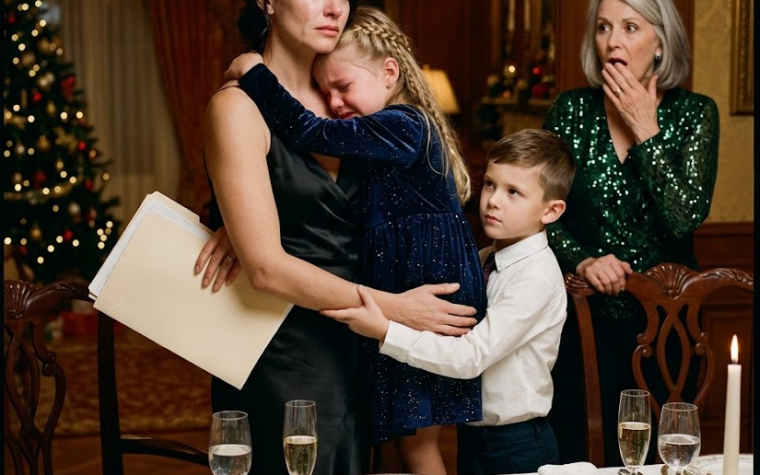
The power-of-attorney papers stayed unsigned.
The $80,000 transfer never went through.
The financial and security records remained preserved for review, along with the recording and the doctor’s documentation of what Mom reported and the injuries he observed.
Clara did not return home with us as though nothing had happened.
The situation had moved beyond something she could smooth over with a sympathetic smile and a story about an elderly woman falling down.
Statements had to be taken.
The confinement and financial activity had to be examined.
Clara, who had spent months deciding who was believable, no longer controlled who would be heard.
When Mom and I finally returned to the house, I walked upstairs with her.
The bedroom door was still open from that morning.
Mom stopped in the hallway.
For several seconds she simply stared at it.
Then she stepped inside.
The room looked even worse in daylight.
I wanted to apologize for not being there.
For not noticing sooner.
For every call during deployment when Clara had said everything was fine and I had accepted the answer because I needed to believe home was safe.
Mom seemed to know what I was thinking.
“Don’t,” she said.
I looked at her.
“I should’ve known something was wrong.”
“You knew when you saw it.
That’s what mattered.”
She crossed the room and pulled the curtains open.
Sunlight flooded a space Clara had kept dark.
Then Mom held out her hand.
“My phone.”
I retrieved it from where Clara had hidden it with other household items and returned it to her.
Mom turned it on, checked the screen and shook her head.
“Do you know how many times she told me I’d forgotten where I put this?”
I didn’t answer.
There were some kinds of cruelty that sounded small when described individually.
A missing phone.
A changed email address.
A locked door.
A neighbor told that someone was confused.
Put together, they became a cage.
Over the following days, I organized everything the way I had once organized fraud cases: dates, account records, login histories, the transfer request, the deleted footage logs and the recording.
Mom gave her account in her own words.
No pretending this time.
She was furious about the bruises.
She was even angrier about the dementia story.
“She didn’t just want people to think I was sick,” Mom told me.
“She wanted me to start wondering whether I was sick.”
That was the part I understood only after she said it.
Clara had not merely isolated her physically.
She had tried to make reality negotiable.
Every protest became proof of instability.
Every demand for independence became aggression.
Every attempt to contact someone became confused behavior.
Once the people around Mom accepted the premise, Clara could reinterpret almost anything she did.
Except evidence.
Evidence did not care who sounded more sympathetic across a garden fence.
The account logs did not care how elegant Clara looked while explaining herself.
The pending transfer did not care how often she used the word “care.”
And the recorder did not care what context she claimed later.