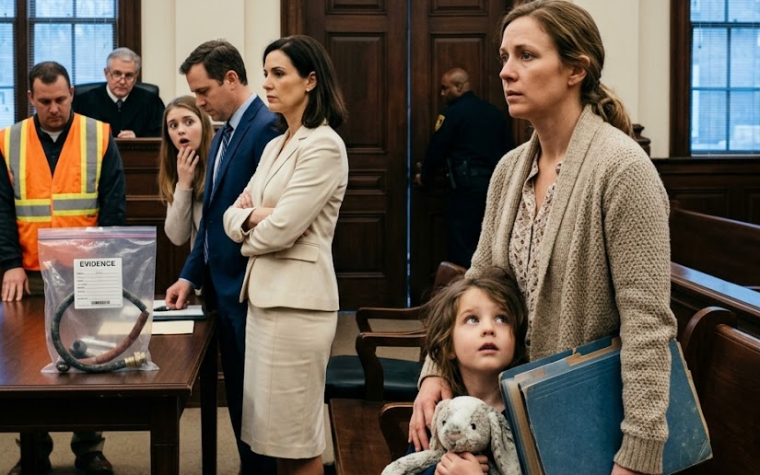
That almost made it more powerful.
There was simply evidence.
The hospital documentation.
The neighbor’s testimony.
The timeline.
My calls.
The security video.
Melissa’s changing explanations.
The fact that Norma knew Sarah had been abandoned before I explained it to her.
Melissa’s attorney argued that she had made a terrible error in judgment, not an intentional decision to endanger a child.
He said she believed Sarah could get back into the house.
He said emotions had been high and that the family needed space to heal.
The judge watched the recording.
He watched Sarah test the locked door.
He watched the car leave.
He watched the rain begin.
He watched a child sit beneath a porch light while the adults responsible for her stayed gone.
Temporary primary custody remained with me, with Melissa’s contact restricted according to the court’s safety conditions while child-welfare investigators completed their work.
It was not a victory.
Nothing about standing in court because your daughter spent hours abandoned outside feels like winning.
But it meant Sarah would not be handed back into the same situation while everyone debated whose version sounded nicer.
Norma tried once more to explain her phone call.
She said “not our problem anymore” had been taken out of context.
Chris later asked me a question I have never forgotten.
“What context makes that sentence acceptable when the subject is an injured eight-year-old?”
There wasn’t one.
The child-welfare investigation ultimately concluded that Sarah had been left without adequate supervision and access to shelter.
The police report went forward for review, while the family court focused on immediate safety rather than waiting for every other process to finish.
Melissa moved out of the house.
For a long time, Sarah could not sit on the front step alone.
If I went to the mailbox, she watched from the window until I came back.
If I said I was running to the store, she asked exactly how many minutes I would be gone.
At bedtime, she sometimes asked whether the doors were locked from the inside or the outside.
Those questions broke something in me each time.
So we built trust again in ordinary ways.
I told her when I was leaving.
I told her when I would return.
If I was going to be ten minutes late, I called.
Chris came over for dinner almost every Sunday.
Carolyn kept an eye on the house without making Sarah feel watched.
The first time Sarah crossed the driveway by herself to bring Carolyn a plate of cookies, Carolyn pretended it was completely ordinary.
Maybe that was exactly what Sarah needed.
Months later, I asked Chris why he had sounded so cold in the ER that first night.
I had mistaken his calmness for emotional distance.
He shook his head.
“I wasn’t calm,” he said.
“I was furious.”
“Then how did you think that clearly?”
He looked toward the living room, where Sarah was doing homework on the floor.
“Because angry people want a confession,” he said.
“Kids need a record.”
That was the lesson I carried out of the worst night of my life.
Not that rage is useless.
Mine was real, and some part of it will probably always be there.
But rage would not have shown a judge the locked door.
Rage would not have preserved Carolyn’s recording before it could be overwritten.