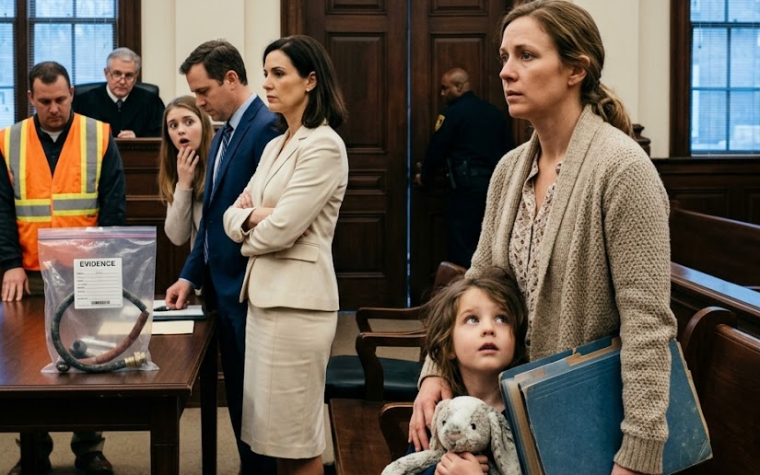
The recordings.
The delayed emergency call.
The conflicting explanations.
The officers separated Margaret and Caleb immediately.
Their stories began to diverge within minutes.
Caleb said Mother had controlled the financial scheme.
Mother said Caleb had forged the signatures.
Caleb admitted he had pressured Emily to stop investigating but claimed he never wanted medical help delayed.
Margaret insisted she believed there was still time.
Neither could explain why my wife had been brought back to the house and placed in a coffin before I arrived instead of allowing me to receive a clear account from medical personnel.
The answer emerged later through records and interviews.
After Emily died, Margaret had focused on controlling what I would see when I returned.
She believed grief, exhaustion, and the shock of meeting my newborn son would prevent me from examining the paperwork closely.
She had arranged the room like a final scene.
The coffin.
The blue dress.
The carefully arranged hair.
A completed tragedy with no questions left to ask.
But Emily had left one question clenched in her hand.
The financial investigation moved quickly once my attorney turned over the trust documents.
The attempted property transactions were invalid because Mother and Caleb never had the authority they claimed.
The accounts connected to the transfers were frozen.
The forged signatures became part of the criminal investigation.
The more investigators examined, the worse it became.
Money had been taken in smaller amounts over months because Margaret believed repeated modest transfers would attract less attention.
Caleb had helped communicate with intermediaries and had participated in efforts to pressure Emily into signing documents that would have made later transactions easier.
Emily’s refusal had stopped the most serious property transfer.
Her recordings proved she knew exactly what they were doing.
The medical investigation was more painful.
No one could promise me that Emily would have survived if the emergency call had been made earlier.
Medicine does not always offer that kind of certainty.
But the timeline established something undeniable: help had been delayed during an emergency while Margaret continued arguing about documents.
That fact became central to the case against her.
Caleb eventually cooperated with investigators.
His cooperation did not erase what he had done, but it confirmed key parts of Emily’s recordings and financial evidence.
Margaret continued denying responsibility long after the evidence became overwhelming.
She said she had only been protecting the family.
I never understood how she could say those words while speaking about actions that had destroyed mine.
Months later, I stood in the same living room holding my son.
The coffin was gone.
So were Margaret and Caleb.
The fireplace had been cleaned.
Emily’s blue dress was packed carefully with the few belongings I could not yet bear to see every day.
The house remained protected by the trust.
Not because I had outsmarted anyone.
Because Emily had refused to surrender the truth.
I often thought about her hand.
Even at the end, surrounded by people trying to control the story, she had held on.
Literally.
The memory card had left small marks in her palm.
For weeks, that image haunted me.
Eventually, it became something else.
A reminder.
Our son would grow up knowing his mother was more than the woman in the coffin he would never remember.
She was observant.
She was stubborn when being stubborn mattered.