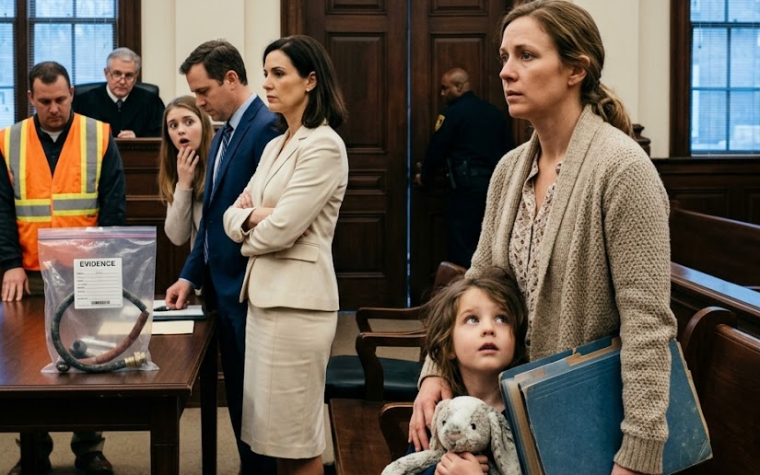
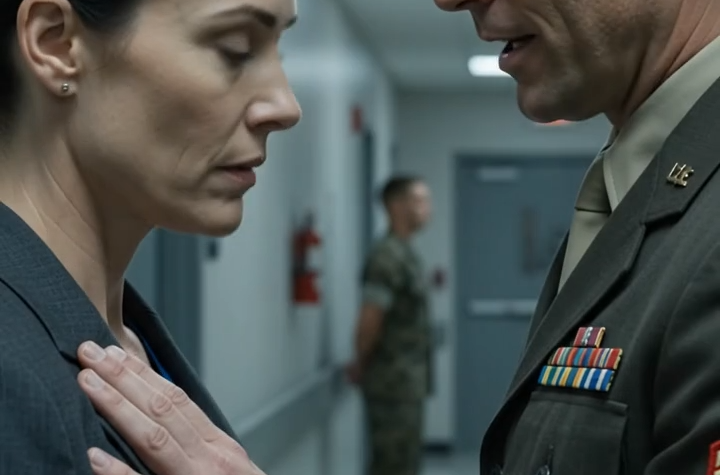
For a moment, I thought she would retreat into silence again.
Then she turned around.
“I asked you to take him,” she said, “because I thought his father would keep him safe.”
Thomas lunged one step forward.
The officers blocked him immediately.
That movement—the sudden rage, the clenched hand, the way Ellie recoiled before he even touched her—said more than another hour of explanations could have.
He was escorted away from the pediatric area.
Mason remained in the hospital overnight.
I sat beside his crib while monitors blinked softly in the darkened room.
His cries were quieter after the pain medicine, but every small sound still made me sit upright.
Near midnight, he opened his eyes and wrapped his fingers around mine.
I cried then.
Not for Thomas.
For Mason, who had learned pain before he had learned how to roll over.
For Ellie, who had mistaken fear for helplessness until her baby paid the price.
And for myself, because some part of me still remembered Thomas at two months old, sleeping against my chest while I promised nothing would ever hurt him.
I had kept that promise as long as I could.
He had grown into someone willing to break it for his own child.
The investigation moved quickly after the hospital documented the injuries, Ellie gave her statement, and the nurse confirmed what Thomas had said on speakerphone.
His messages to me were preserved.
So was the timing of my arrival at the apartment, the hospital intake, and the medical finding that Mason’s injuries predated the hour he spent in my care.
Thomas was taken into custody.
The final charges and court decisions came later, but he was immediately barred from contacting Mason.
Ellie was not allowed to take the baby home.
Her decision to conceal the injuries and help create a false story had consequences too.
She began cooperating with the investigation and was granted only supervised contact while the court considered whether she could ever provide a safe home.
After an emergency review and a home inspection, Mason was placed with me.
The first night he slept in my house, I put his crib beside my bed.
I woke every hour to check his breathing.
For weeks, he startled whenever someone moved too quickly near him.
Diaper changes made him cry because lifting his legs pulled at his healing ribs.
Slowly, the bruising faded from black to purple, from purple to yellow, and then disappeared.
The fear took longer.
Thomas wrote me one letter from custody.
He said Ellie had exaggerated.
He said the hospital wanted someone to blame.
He said I had destroyed the family by refusing to handle the problem privately.
At the bottom, he wrote, “A mother is supposed to protect her son.”
I read the sentence twice.
Then I placed the letter in the same folder that held Mason’s medical records and the temporary custody order.
For most of my life, protecting my children had meant standing between them and danger.
Thomas believed it meant standing between him and accountability.
He was wrong.
Months later, Mason sat on my living room rug wearing a soft green onesie.
He could hold his head up by then.
He smiled when I sang the thunderstorm lullaby, the same song that had failed to soothe him in the apartment because pain had drowned out everything else.
Ellie visited under supervision.
She never asked me to forgive her.
She focused on Mason, followed every rule, and accepted that rebuilding trust would take longer than apologizing.
I did not know what the court would ultimately decide for her.
I only knew that Mason was safe that day.
Sometimes people ask how I found the courage to uncover the bruise when my own son had warned me not to look.
It was not courage.
It was the sound Mason made in my arms.
Babies cannot explain who hurt them.
They cannot show you a message, name a witness, or ask to be taken somewhere safe.