My son’s recorded voice filled the great room of my Aspen cabin.
“Once he signs nothing, we use the capacity report.
Then the court gives us control.”
The words sounded colder coming through the small black recorder than they had when Elias first played them for me in his office.
Perhaps it was the setting.
The cedar walls.
The snow beyond the windows.
The suitcases my son and daughter-in-law had pushed into my home less than ten minutes earlier.
Trenton stared at the recorder as though another man had spoken in his voice.
Deborah did not look surprised.
She looked furious.
“That recording is edited,” she said.
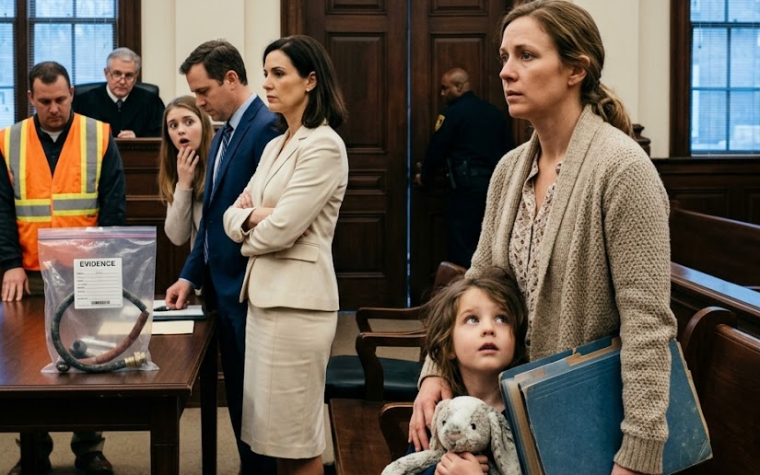
Elias Grant opened the black evidence case beside his chair.
He removed a phone sealed in a clear bag and placed it on the walnut table.
“The complete file came from your automatic cloud backup,” he said.
“Forty-three minutes and twelve seconds.
No cuts.
No missing sections.”
Deborah’s gaze fixed on the phone.
It was the first crack in her composure.
Miriam Cole, my attorney, pushed the first photograph toward the center of the table.
It showed Deborah inside a private bank office, handing a document to a notary while a property transfer form lay open in front of them.
My son appeared in the reflection of the glass wall behind her.
Helen Park, the notary now standing beside the fireplace, folded her hands.
“Mrs.
Winston contacted me three weeks ago,” she said.
“She claimed her father-in-law was housebound and unable to appear in person.
She asked whether I would notarize his signature based on a video call.
When I refused, she offered additional payment.”
“That is a lie,” Deborah snapped.
Helen reached into her leather portfolio and removed a printed statement.
“This is my sworn account.
I also retained the messages.”
Deborah turned to Trenton.
“Say something.”
He gripped the back of a chair so hard that his knuckles turned white.
“Dad, I didn’t know she was trying to forge anything.”
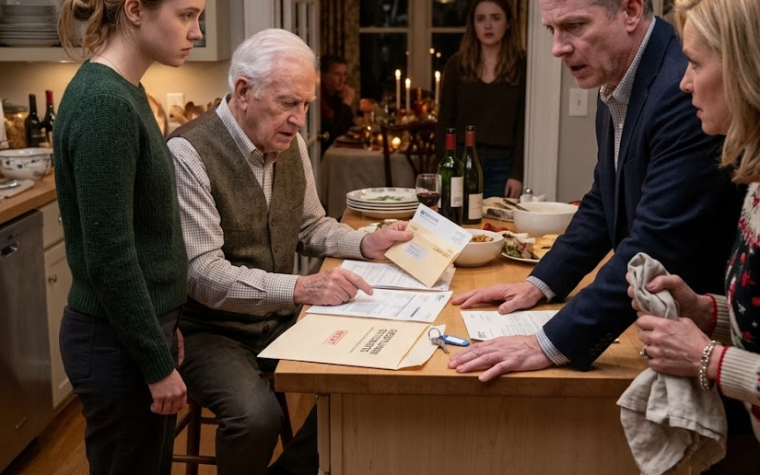
I looked at the documents that had spilled from his suitcase.
His name and signature appeared on the petition for emergency conservatorship.
They appeared again on an affidavit alleging that I forgot appointments, became confused about money, and had recently made reckless purchases.
The reckless purchase was my cabin.
The money confusion was my refusal to tell them how much I received when I sold the restaurant chain.
“You signed six pages describing me as mentally impaired,” I said.
“She said it was only in case something happened.”
Deborah laughed without humor.
“Do not put this on me.
You signed because you agreed he shouldn’t control that much money alone.”
There it was.
Not concern.
Money.
For thirty-two years, I had built restaurants one exhausting decision at a time.
I started with a diner that smelled of burned coffee and old fryer oil.
I repaired the ovens myself because I could not afford a technician.
I slept in a booth during the first winter because the pipes froze at my apartment and I needed to keep the restaurant’s water running.
When Trenton was young, he spent Saturdays in the kitchen with me.
He learned to sharpen knives, balance a ledger, and tell whether bread dough was ready by pressing two fingers into it.